
Back to Main Planning and Scheduling Page
2025-2026 School Year – Planning
M will be in Year 7 and Em will be in Year 4. This is my first time through Year 7.
- Overview
- Weekly Schedule
- Bible
- History
- Biography
- Language Arts
- Foreign Language
- Geography
- Citizenship
- Science
- Nature Study
- Mathematics
- Art
Overview
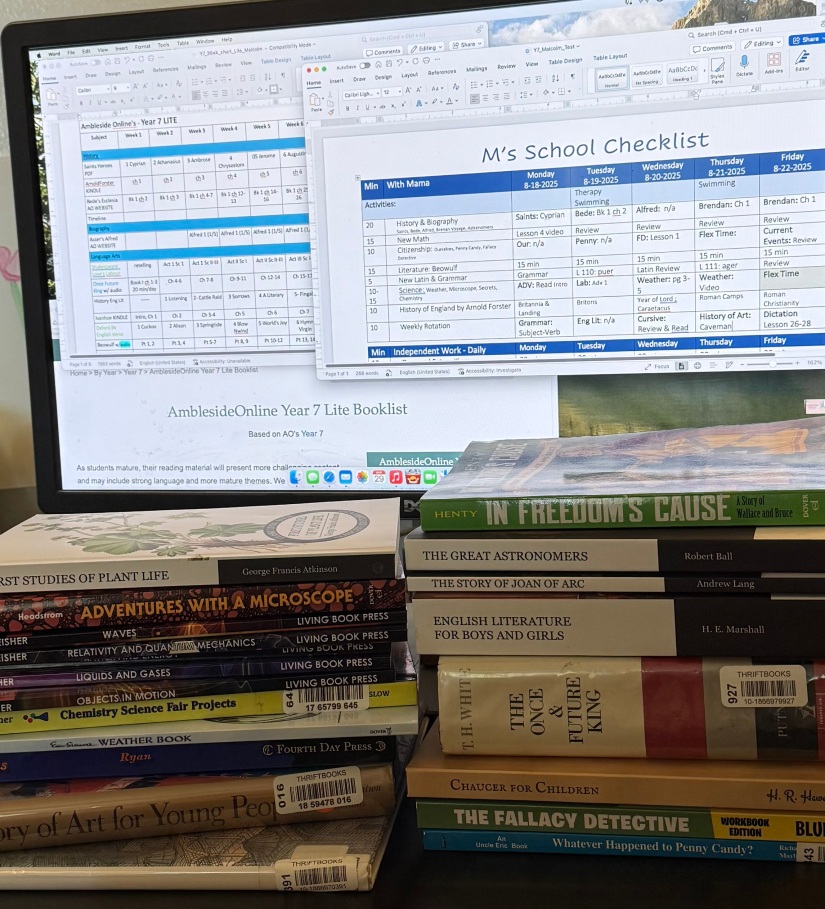
We will be using a lighter version of the AO7Lite for M. M tends to move more slowly through the readings and takes longer to process what he’s learned. I have skimmed through all of the recommended readings for AO7 and AO7Lite and chosen a selection for M to read. I have also found additional readings I think are important, relevant, and will be interesting to M to replace or supplement some of the AO recommendations.
Year In Review
In Review
In the fall of this year my husband was offered a position on the other side of the country. This meant that we had to get our house ready for showing (including painting kitchen cabinets and storing a Pod’s worth of what the realtor called clutter – mostly our books!), pack, drive across the country, live in a VRBO for two months while searching for a new home, then finally move in and unpack that new home. This took us from November through May.
I tried to keep as much of a normal school schedule as possible. We took less time for Christmas break than planned and had to drop some items from our schedule – such as anything we needed the packed microscope for or plant growing projects. I downloadeed as many e-books as I could to replace packed books, then shipped the remaining three boxes of books via bookrate to our temporary address (they got there before we did!). There were a couple of weeks right before the move and while moving into the new house where all the school that happened was independent readings (history, biographies and free reads) and math review worksheets. I did that so I could be working on moving tasks while they worked completely independently.
On the drive across the country, we did “road trip school,” where I had Em track the mileage every day and graph it at the end. We kept a journal of all the states we crossed through. In several states we stopped at historical or cultural sites. We read the maps and planned our drives together. And we listened to the entire Chronicles of Narnia (Em didn’t remember the first time we went through them).
In the end we finished most of the history and literature readings I had planned. Morning school and science experiements were reduced. I kept up with counting the school attendance per California requirements and in the end we had more school days than necessary. This included my counting of “field trip days” when we visited museums etc. It was a tough year, and we’re still not totally unpacked, I’m behind in planning for next year, and we skippped some things I had hoped to cover. Our normal weekly schedule also changed a bit once we were settled into the VRBO and again into our new home. Since we moved to an area with so many museums and historical locations, I decided to do a field trip once a week as often as we could. We also joined a homeschool group that went on nature walks on Fridays which meant shortening the Friday schedule. So we were doing lessons 4 days a week, with the fourth being slightly reduced to make time for the nature group. But I’m calling it a successful year.
Weekly Schedule
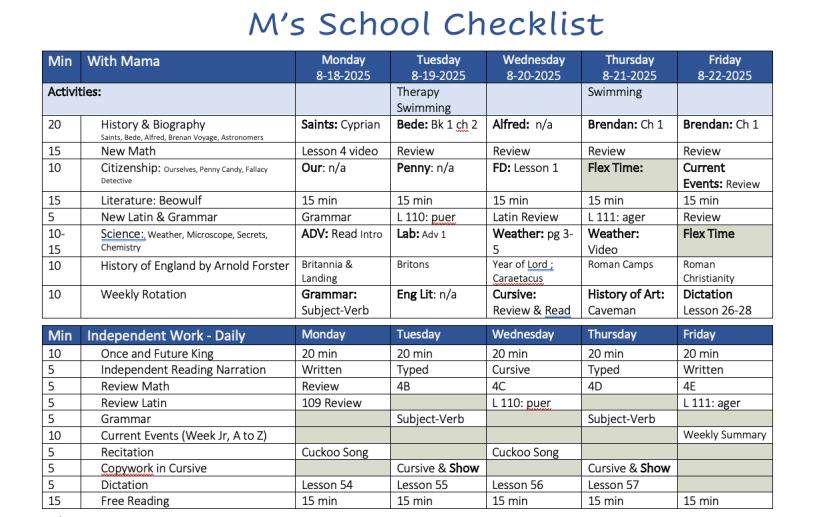
Every week I will make a weekly schedule for M to follow (see Planning and Scheduling for further details). I plan out what he will do independently and what he will do with me and make sure it can all fit into the school time allotted. This is not all of his work since we also spend 45-60 minutes in Together Time first thing in the morning (Together Time template here).
Bible
Bible is split up into Together Time and Vespers and then by the time of the year. This year we will cover the following:
| Together Time | Vespers (see Liturgical Year for details) | |
| Aug – NovOrdinary Time | Finish up Ezra, Nehemiah, and Jonah ; Weekly Proverbs | Joshua |
| Advent | Hallelujah by Cindy Rollins | Advent Readings |
| Christmas | N/A (no school) | Christmas Readings |
| Jan/Feb | Special Study: (TBD) ; Weekly Proverbs | Luke |
| Lent | The Sacred Sacrifice by Hannah Paris | Lent Readings |
| Easter | Job ; Weekly Proverbs | Acts |
| Jun – Aug Orinary Time | n/a (no school) | Judges |
AO has Proverbs scheduled for Year 7, so I have decided to add that in to our morning reading. I will follow the schedule above Mon – Thurs, and read the AO weekly assigned Proverb on Friday.
Check Out the Other Guides pages for Bible Reading schedules (I’ll post them as I create them).
Sunday Readings during Vespers we’ll continue with Parables of Nature.
For Bible Memory, we work through one or two passages a term in Together Time. I will use the suggestions from AO for Bible recitation for AO4 and AO7.
Bible In Review
When we started packing, Bible in was our Advent readings. When January and intense packing started, morning time started to suffer. We kept up with prayer and memory verses, but I didn’t have time to prepare a special ordinary time study. We did make our way through a good portion of The Sacred Sacrifice for Lent, but then we moved into the new house over Easter weekend, so further Bible readings didn’t happen. Our Vespers time also ended up being mostly listing what we were thankful for that day and prayer. My husband gets home later from work, baseball practice goes late, and dinner is later. So our evening time is more rushed than before. We are missing our full Vespers time and hopefully will settle into a new routine here and bring it back soon.
History
- We will be using the Saints & Heroes pdf linked from AO and keeping the AO schedule over three terms and I will be reading it aloud to M.
- I have opted to use Arnold Forster’s A History of England instead of Churchhill’s because I think M will be able to follow the stories better. I will be reading this aloud from the free download available on archive.org and linked in AO. I am planning on keeping to the AO schedule over three terms. Tough we’ll see how much M absorbs each reading and may have to slow down the pace.
- I will read aloud the Bede’s Ecclesia for term 1, using the linked docuement on the AO website.
- In term 2, I will read aloud the Battle of Hastings and Magna Carta from documents listed on the AO website
- I have Timeline scheduled for once a week for us to add in any significant events or people we’ve read about that week.
I have decided not to schedule The Daughter of Time this year. I have read this and know that M is not ready for the book, so I will add it in later.
History in Review
We made it through the first four or five people in Saints & Heroes in term one. Each week we would read a little bit, sometimes taking several weeks to get through one person. M had a hard time following the stories and then remembering what we had read the previous week. This would have probalby worked better as a daily reading, but it just didn’t fit in the schedule. Therefore, when things got busy, it was one of the readings that was dropped.
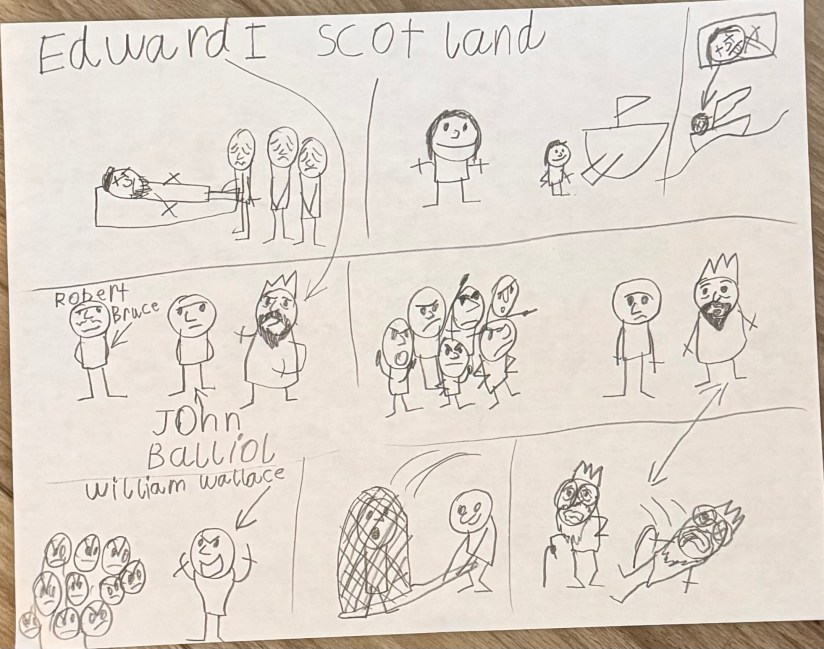
The Arnold English History book worked out really well. I ended up buying a physical copy – just because it is easier for me to read and divide up the readings when I can easily flip through. I did not follow the AO schedule as I had planned. Instead, I just put it on the schedule for me to read it to M every day. After several weeks I realized M was having a difficult time remembering and keeping the stories straight. Even though his daily narrations were relatively well done. So I had him start a journal where he would draw the stories. This really helped him because every day we would go back and look at the drawing for the last couple of stories and every couple of weeks we’d go through all the drawings. In retrospect, I would have had him write a little more so months later we would still remember who it was he was drawing.
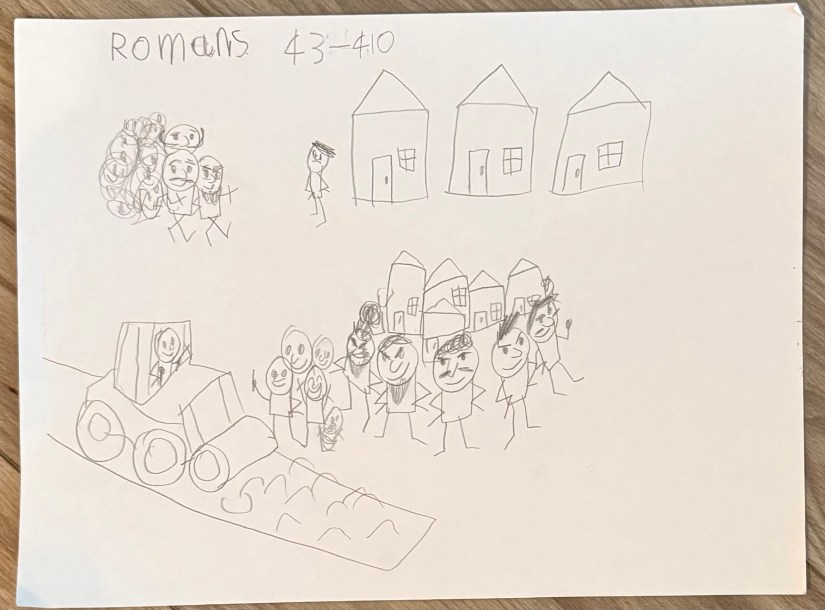
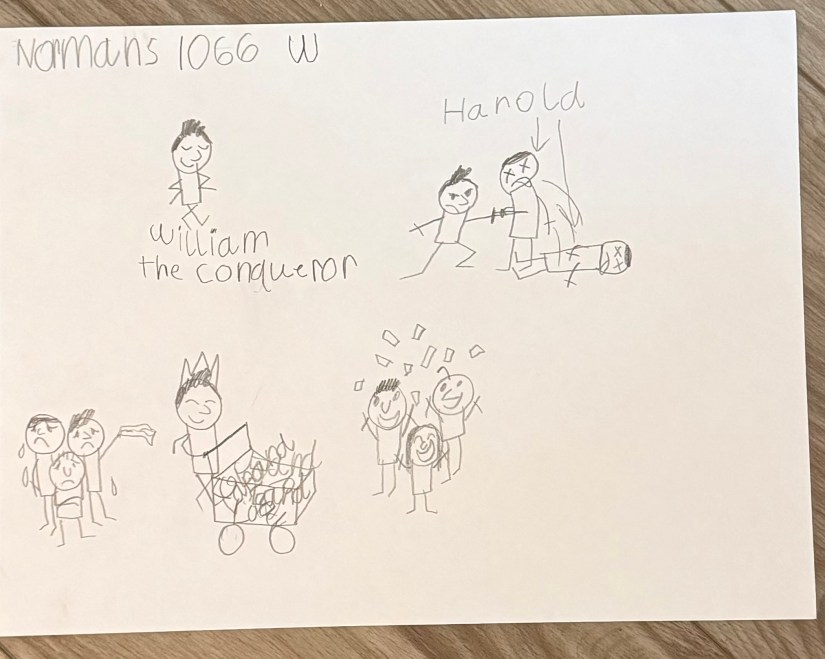
We did not do the historical readings. I tried the first and realized it was not going to work for M. He also is not at all interested in the book of centuries, so we only added a couple of entries all year. I figured the History of England Journal was enough of a timeline for him.
Biography
- In term 1, I will read the selections from The Life of King Alfred as scheduled. I’ll use the document linked in AO.
- In term 2, M will listen to the Audio of In Freedom’s Cause and follow along with the book. I have a docuemnt with my pre-reading notes (see Other Guides) I will reference for narrations. The document includes maps and several links to photos or videos I will show him as well as a listening schedule to fit it into one term.
- In term 3, we will read the shorter Joan of Arc biography by Lang instead of the longer one by Mark Twain (which I hope to read with E when he gets here, but this one suits M better). M will listen to the Livribox audio recording while following along with the book. I will listen before he does so I can follow along with the narrations. The audio works out to be about 10 minutes per week.
Biography in Review
I started out reading Alfred to M, but it just made him frustrated. Same with Freedom’s Cause. I at first started out having him follow along independently to the audio book. But he could not narrate it at all. Then I sat with him and stopped in frequently to help, but we were stopping almost every sentence or two. It was frustrating for both of us. I had enjoyed this pre-reading, so I was disappointed it didn’t work out. Both of these readings were dropped by the end of the first term. When I dropped them, I bumped up Joan of Arc. I ended up having him read them on his own (not listen to an audio recording), and he followed the story and his narrations were done well. By the time he finished it, we were in the middle of The Move so I didn’t add anything else in.
Language Arts
Shakespeare
For Shakespeare, we will be reading Love’s Labor Lost (since our local Shakespeare in the Park will be performing it this summer), Julius Ceasar, and Much Ado About Nothing. We’ll read one of the retellings at the beginning of the term familiarize ourselves with the story. Then read the listen to the play together while following along. This will be the first year this will be during morning school since Em will be in AO4 and starting the full plays this year.
Shakespeare in Review
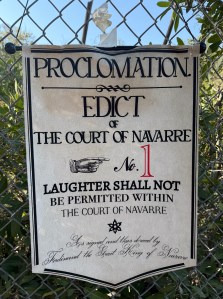
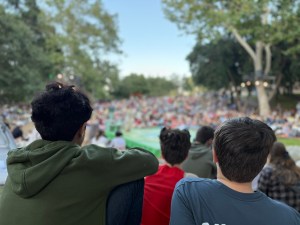
Love’s Labour’s Lost was a huge success. We read the Lamb’s retelling with our friends the week before we went to the Indie Shakes performance. We went on a night when they did a little workshop for kids before the play, so they got to learn about actor warm ups and learn some lines. They enjoyed the play so much, that they begged to watch the full movie version after we had finished reading the full play along with the Argo Classics audio version. In fact, just last week (in June!), M was wishing he could watch it again – to which I replied that he was welcome to anytime he wanted! (I mean, I’m not going to put restrictions on screen time when he’s asking for Shakespeare – even if it’s ridiculously silly version). It was Em’s first full Shakepeare play and we read a scene, or part of a scene, several mornings a week. I’ve found that if we only read once a week we loose the flow of the story and spend too much time trying to remember where we were.
We also read Julius Caesar. We read through the longer Adam McKeown retelling and then slowly worked our way through the play. Working around The Move, we finished it in April so did not have time to start another one. The boys followed along and enjoyed the YouTube clips of some scenes we watched.
Literature
- In term 1, M will read along with the audio for Once and Future King. It works out to about 20 minutes per day to finish in one term.
- I will read aloud the History of English Literature for Boys and Girls along with the AO schedule.
- Daddy will be reading Ivanhoe to M during bedtime reading. He will start this reading before the start of the school year so that he’ll be done by the end of the year.
- In term 2, I will listen to Watership Down along with M as he follows along with the book. We’ll listen every day to get through the AO schedule.
Literature in Review
It took M two terms to finish Once and Future King. His narrations were well done, but I kept discovering that he would not set his timer for the precribed twenty minutes. Instead, he would stop “when it felt like enough.” Needless to say, it took him almost two terms to finish the reading. When he finally did finish, I gave him Connecticut Yankee in King Arthur’s Court. Which he again did not always set the timer for. His narrations were well done and he says he likes the story, but he did not finish by the end of the school year. So I’m having him finish during the summer. I’m hoping this will be motivation enough for him read the prescribed length of time next year!
I was enjoying the History of English Literature book, but Malcolm was not following. It is the same problem we encountered with Bullfinche’s Mythology: he can follow stories, but add in the “story about the story,” and he looses track and can’t make sense of what’s happening. I stuck with it for a couple months, hoping he’d catch on. But ended up stopping before the end of the first term.
Since we had an opening in our weekly schedule, I decided to read Stories of Roland Told to the Children by H. E. Marshall. We didn’t finish before The Move required I cut some things from the schedule, but M was following along and able to do his oral narrations well. I was only reading once a week though, and this made the beginning of every reading difficult because until I basically retold the story up to the point we left off, he couldn’t remember where we were. This experience made it more clear to me that I need to schedule M’s reading more frequently so he can follow more easily.
I added in daily readings of Watership Down about week 8 when we finished Beowulf (see below). We both listened to the audiobook while M followed along. This took us a little into the third term. I had never read the book, so instead of reading on my own, I decided to just follow along with M. He could probably have read along with this independently, but I’m glad I listened in. One, so I would know the story. And two, to help him navigate the stories within the story. He had a hard time distinguishing the stories told by the rabbits from what happened to the rabbits.
Bedtime reading fell off once The Move commenced, so Ivanhoe was not finished. But I am going to save this for us to read together with Em when he gets there.
Poetry
We do poetry in morning school, so we read from poets assigned to both years. I alternate poetry and folk songs, so we only do poetry three times a week. One day a week we will read the AO7Lite list of poems from the Oxford Book fo English Verse. I will use the document I created (see Other Guides) with the original and AO paraphrases side by side as well as the linked readings when they are available. For the longer poems, I will split them over several days. The other two days we will read from Maya Angelou for Term 1, Alfred Lord Tennyson for Term 2, and William Wordsworth for Term 3.
I will read Beowulf together with Malcolm, listening to the audio version while following along in the book. We’ll read 15 min per day during term 1 and into term 2. I am using the Seamus Heaney translation because I happen to have a copy and there is an audio version available. In term 3, I will read the Golden Key aloud every day to (hopefully) keep the AO schedule.
See my Other Guides/Poetry resources for how I schedule the poems and the resources I use (this page is in progress and does not have all of the poets we’ve read yet)
Poetry in Review
We went through as planned. Though I had pre-read and made the side-by-side printout of OBOEV, it was still a little tricky getting through it. I mostly ended up reading the tranlated versions. We did make it all the way through because when it was scheduled to spread a poem out over several weeks, we just did it in one reading or two readings in one week.
We started out listening to the audiobook of the Beowulf while we both followed along in the book. We read until a good stopping point every day and M followed along well. He had previously read a retelling of Beowulf, so was familiar with the story. The audiobook ended up being abridged (though I could not find it indicated at such!). So I took over reading. I was a little hesitant about reading it myself, not being the best poetry reader, but it worked out and I improved as we went along. The fact that M could follow, narrate and say he liked this story made me feel even better about dropping the other readings that he couldn’t follow. I am not just giving him the easy stuff and “feeding his brain junk food.” This is a complex poem and he did well.
In term three we started The Golden Key. M was able to follow the biographical part about Chaucer, though since we were only reading once a week, it was going pretty slowly. I ended up skipping some of the biographical parts to get to Tales since the year was waning. We got through several Tales, reading through them slowly. If I could do it over for M, I think I would schedule this to start earlier in the year and to be read every day.
Grammar
For Grammar we’ll continue on with Fix It! Grammar about one lesson a week. This year instead of doing grammar every day, I will schedule a new concept on Mondays and independent work on that concept two days a week.
Grammar In Review
After his independent reading went down to only one book a day, M was getting through his independent work really quickly. So I decided to have him do grammar every day. Especially since it included a cursive “copywork” component. And he hardly ever finished the lesson on his own. Every day he would get a one page of the Fix It! Workbook to do independently and then I would review it with him and help him finish what he did not complete. Some days he would forget what an adjective is and some days he would get them all correct. I can’t decide if he’s being lazy sometimes, or if just gets confused sometimes. He knows if he doens’t complete them, he’ll have to do it with me – and he hates having to do that because then “school with Mama” takes longer.
Recitation
This year I will combine recitation with Em and do it in morning school. This makes sense for us since I already combine poetry and Bible and Em will be joining us for reading full Shakespeare plays this year. We will work on recitation together twice a week and they will work on it independently the other three days.
Recitation in Review
We made it through about half of the recitation selections listed above. But my plan to have us work on it once in morning school, once with me on their own, and then independentely the other days worked out well. Em enjoys performing the recitations for me and learning when it is best to take a breath, how to pronouce and emphasize words, and ended up memorizing most of the selections.
M does not like to have people watch him recite, so when we practice in morning school Em and I have to look away. But he is getting better at cadence and pronunciation, but not necessarily with projecting or emphasizing. I think speaking publically will always be difficult for M. But he is practicing and making small improvements, so I will continue to have him do it.
Dictation
We will continue using The Modern Speller by Kate Van Wagenen during morning school. I switched to this in term 1 of last year and it’s been helping improve M’s spelling. As before, I’ll have both M and Em do this in morning school with one new lesson Mon-Thurs. They will review and practice the lesson in independent time and then I will do a dictation lesson with them on Friday using the new words. While M is still catching up with spelling, and Em is just starting dictation, I think this is a good option. I hope to move to picking passages from their reading in the next year or so.
Dictation in Review
Sometime before the year started I changed my mind and decided to go back to working through Spelling Wisdom with M. Each week I print out a sheet from the PDF version I have and then I add a list of several words to the bottom. I choose words that I notice he’s mispelled that week in his narrations. He is assinged to work on learning the quote and these words every day. I ask him how he’s doing with the practice every day in our time together. Some days he says he wants to practice with me and some days he says he’s doing fine. On Friday he writes the quote and words I say on a white board. Though some weeks I have him write on a “worksheet” entitled “Dictation” so I can turn it in to the county at the end of semester and show we are consistently working on spelling.
Copywork
M will continue doing cursive copywork in the workbook The Copyworkbook: Comedies of William Shakespeare. He will do this twice a week. He started this last year but did not finish.
Copywork in Review
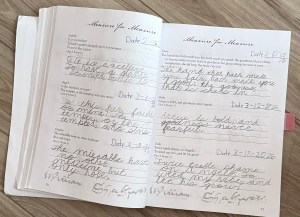
M worked through this again, doing it two to three times a week. He has difficulty remembering many of the cursive letters and even more difficulty reading cursive. So most weeks when I reviewed his work with him, I had him read his own writing as practice. There is also a component of the grammar that requires him to recopy the example with corrections made. I have him do this in cursive for practice as well. He’s not showing much improvement, so I think I’m going to change things up for next year.
Foreign Language
Last year M finally moved from Getting Started With Latin to Keep Going with Latin. So we will keep going with that book. We usually do 2-3 lessons per week. He does independent work translating 4-5 days per week and we review what he’s done or learn something new every day. The lessons are starting to get more complex, so we may not get through as many lessons per week.
Foreign Language in Review
Latin started getting more complicated this year, with longer conversations to translate. I started out giving him the full lesson’s practice every day, but he would only do maybe half and not well. So I decreased the amount of work I was requiring and when it ended up at two exercises per day (every day), he would do them almost perfectly. So, we usually did about a lesson a week. Still making progress, just slowly.
I am still holding off on a modern language because I know it will require daily conversational practice. I think this will be best if all of us learn a new language together when Em is ready to add in a new language.
Geography

Each year we choose a continent (or one year, the State of California), to work our way through in morning school. We cover the map, physical features, history, original peoples and/or current peoples, and sometimes mythology or folklore for each country on the continent. We’ve spent a year on Africa, a summer on Australia, two years on the U.S.A., and one year on California and South America. I used Heritage Mom’s Amazing Africa!, and I’ve posted my guides for U.S.A., California, and South America in Other Guides. This year we’ll go through the U.S. Territories, the Carribean Islands, and Central America. As I complete them, I will post these studies in Other Guides.
In term 1, I will read the Brendan Voyage while M follows in the book. To keep with the AO schedule, we’ll read twice a week.
Geography in Review
Because of his dyscalculia, maps are difficult for M to understand. It is a challenge getting him to even focus on a map. During our morning school lessons I ask M the easier map questions and phrase the questions in a way M has an easier way of understanding. For example, instead of pointing to an unlabeled map and asking what country is this, I instead ask if he can point to Belize. And I tend to ask him the same ones every week for a while so he will after much repetition, finally be able to identify some countries and bodies of water.
What I had planned out for morning school geography changed as I got into preparing the lessons and realized there was no way to do Mexico and Central America in one term. We did the U.S. Territories in Term 1 and I split up Mexico and Central America into term 2 and 3. We were not able to do much map drawing this year, so I hope to be able to incorporate that more next year.
I started out reading Brendan to M once a week. He could follow along and narrate, but then would forget by the next week. Since we ended up dropping some literature and history readings, I added in Brendan to the empty spots in the weekly schedule. We ended up reading for about 5-10 minutes two to three times a week. And it took us most of the year to get through. I would show him the maps in the book and compare it to the location on our globe, but he rarely was interested or could answer questions about the maps. This reading ended up being less of a geography text and more of an adventure/biography/history text for M.
Citizenship
I have scheduled Citizenship for 10-15 min each day of the week. We will follow the AO schedule for Ourselves and Penny Candy. I’ve also included Fallacy Detective in the Citizenship category (though AO places it in Logic, it just fit in the schedule in the Citizenship slot.) I will read each on one day per week. The fourth day I will review with M what he has written for his Current Events narration. For Current Events, we will continue to watch The World From A to Z daily in morning school and subscribe to The Week Jr (which they read in free time). M will be assigned to write a summary of something from watching or reading the news that caught his attention that week. The citizenship slot for the fifth day will be a flex day to catch up with any readings we did not get finished on the assigned day.
Plutarch. As much as I want to continue with Plutarch, I realize this is not something M is mature enough to understand. I tried in Year 4, Year 5, and the beginning of Year 6. We made it through several lives, but slowly and painfully. I plan to start again when Em is in Year 5 and do it together so M can see how Em narrates. I have found this helpful in other subjects as well.
Citizenship in Review
We plugged along with the readings in Ourselves, but ended up using the readings marked out in the Annotated Youth Edition. M seems to be following along with the premise of the Kingdom of Mansoul representing the human, though most of the specifics of the governence and roles of the “people” are lost on him. He is still able to narrate what I’ve read to him so he is getting something out of it.
We read the first six chapters of Penny Candy. M was able to understand and was even interested in how money came about and especially enjoyed the stories of people cutting off parts of coins. He even grasped the idea of inflation. However, as we got further into the book, I began to disagree with how it was presenting economic theories. For example, it blamed inflation on governments and elected officials instead of how our capitalistic society works. I put the book aside because it was too difficult to explain these topic to M. I might be able to use the book with E and have deeper discusions.
The same thing happened with Fallacy Detective. M was able to grasp much of the logical reasoning. But as we got further into the book, I started to disagree with the actual examples used – the book has a definite worldview that it is pushing and it is not one I agree with. I believe it is important to show our students worldviews that are different from our own. However, the way the underlying assumtions were made in this book was not presenting an alternative worldview, but stating as fact and logical that which is opinion and perhaps was not logical. So I dropped this book as well. I am on the hunt for an alternative to use when Em gets here.
Science
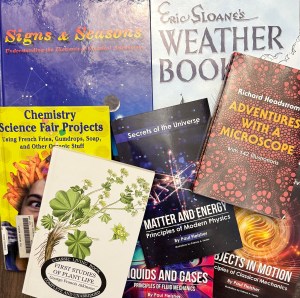
Just looking at AO7 science made me panic. Even the AO7Lite version I knew would be too much for M to get through. So I went through all the books, cut some, chaged the schedules of some, and replaced others. I have prepared a document that outlines what we’ll be doing each day per week for all 36 weeks (See Other Guides). It lists labs and activities and the supplies I will need. I decided to do Plant Studies and Signs and Seasons in Morning School. Mainly because these activities will end up being more family activities than M specific, so I might as well include Em. Especially since Em is capable of learning all that is studied in those books.
Great Astronomers is not included in the Science document mentioned above. I will be reading this aloud to M along with the AO schedule.
I decided not to include the following from the AO7Lite schedule:
- Life of the Spider or Social Life of the Insect World. We studied insects in nature study and read a nature lore book about insects when M was in year 6. I knew M’s reading load was already getting to be too much for him and something would have to be cut. I anticipate including one of these for Em when he gets here.
- Relativity and Quantum Mechanics from the Secrets of the Universe. There were not many readings from this volume of the series and I was running out of space in the schedule. So I decided to cut this one since it was the one M would most likely have trouble understanding.
- The Wonder Book of Chemistry. After reading through about half of this book, I decided that M would not follow much of it. So I am substituting it with a simpler Chemistry book with lots of simple demonstrations.
- Fearfully and Wonderfully Made. These short chapters contain concepts that Malcolm is not mature enough to process. I did not need much of an excuse to make M’s schedule more manageable for him, so this one didn’t make the cut.
Science in Review
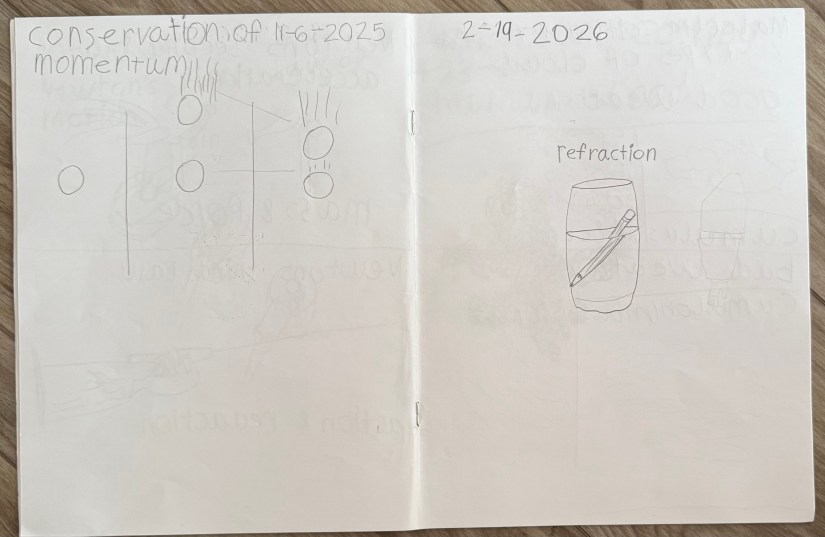
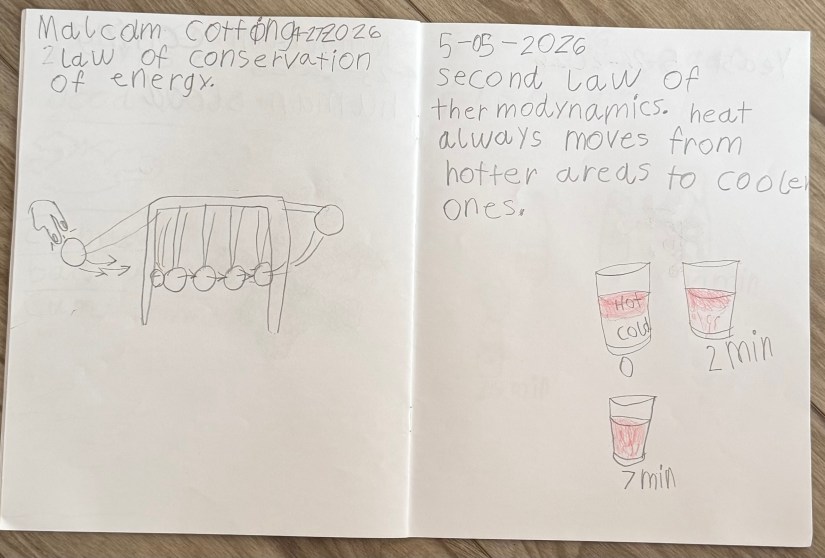
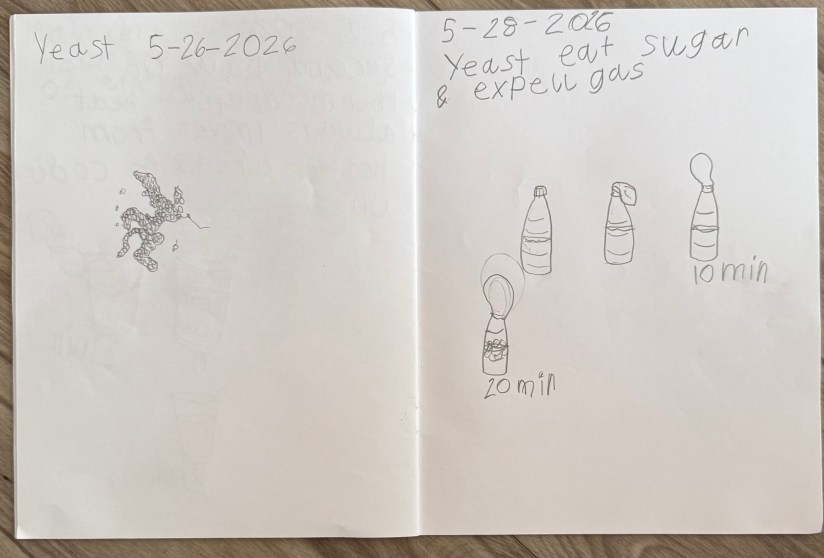
After all the detailed planning I did on my Year 7 Lite(er) schedule, we ended up not being able to follow it well. The Move made it impossible to do a lot of the Signs and Seasons and Plant Life activities I had planned for morning time. I’ve shifted those to Year 8. Many of the activities in Adventures in Microsope, Chemistry Science Fair Projects, and the physics books were also not possible since so much was packed for so many months. I also ended up not reading the weather book to M. After trying for several weeks I realized he just could not follow it. Instead, I used the videos I had found to accompany the readings and just watched the videos and discussed the concepts with him.
Each week as I was writing up the weekly schedule for the next week, I would look at my detailed science excel sheet and find what reading or experiement was possible. We made our way through a majority of the physics books since many of the demonstrations were simple enough with everyday items (putting a pencil in a cup of water simple).
For the microscope activities we did at the begining and end of the year, most were a disappointment. Even though I had done research and watched videos on what I should be seeing, we rarely could figure out what we were looking at with any confidence. We looked, we drew what we saw, but that was about as far as it went. This is one limitation that I am most worried about – my lack of a biology degree or college courses that qualify me to teach it. So far I have been able to learn along with or just ahead of them when they were covering things I have never learned. But I am feeling inadequate with the microscope lessons. I will need to do some serious research over the summer to see how to proceed next year and what to do when Em gets here.
We read Ptolomy and Copernicus from Great Astronomers, but will move the others to Year 8 readings.
Nature Study
We do nature study object lesson and/or observations one or two times per week plus a nature lore book once per week in Together Time. This year we will be covering the following topics:



- Term 1: Reptiles
- Term 2: Brook, River, Ocean (though more of an emphasis on ocean, ocean life, and tides)
- Term 3: Garden Flowers / Weeds (Though I’m reserving the right to switch to succulents)
All my nature study schedules with object lesson ideas and observation helps are located on the Nature Study page.
Nature Study in Review
As I suspected when I was planning for term one and two, the observation portions of the study were clumped into field trip days. We did an object lesson every day, but then went on trips to see reptiles and hikes along streams and estuaries. The two most memorable trips were a trip to The Reptile Zoo and a weekend at a beach front hotel to watch the king tides in December.
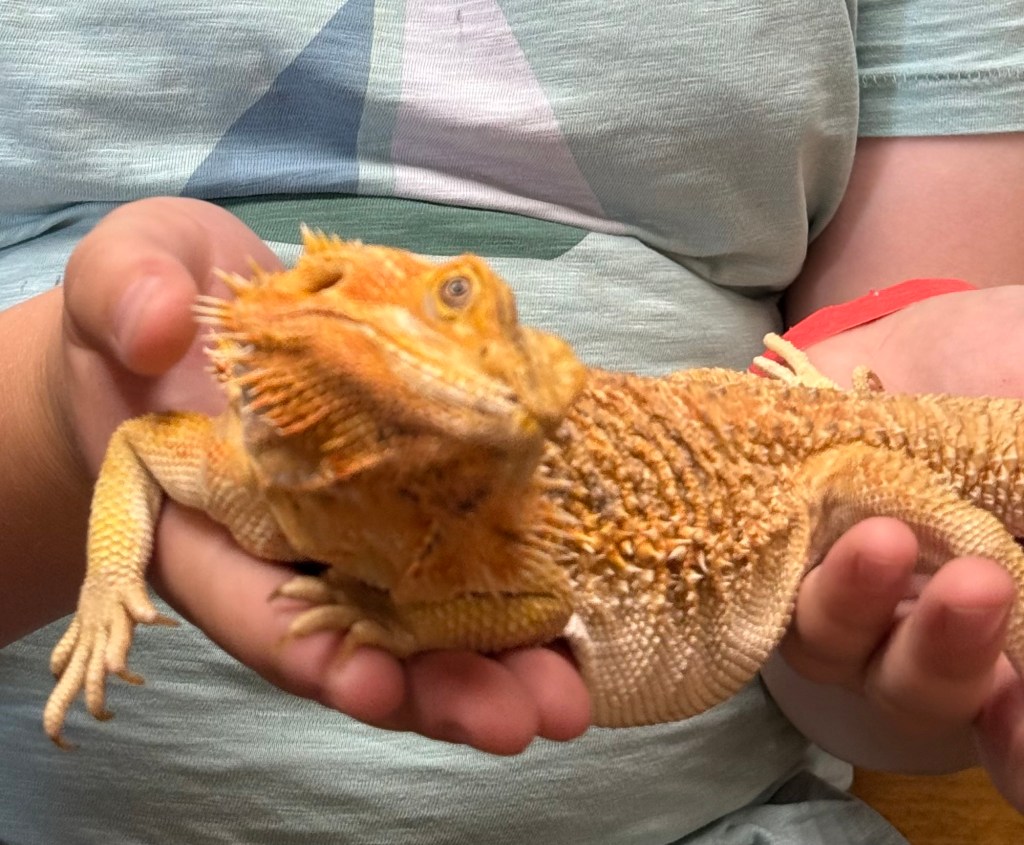
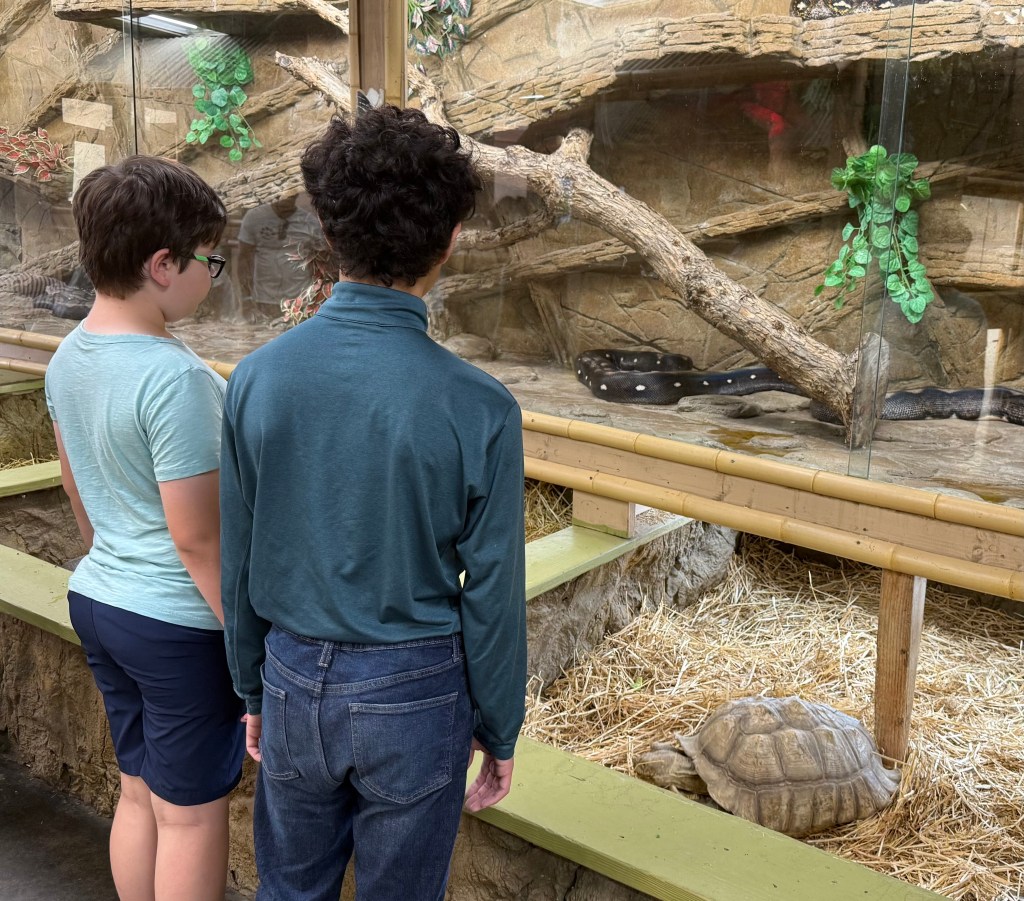
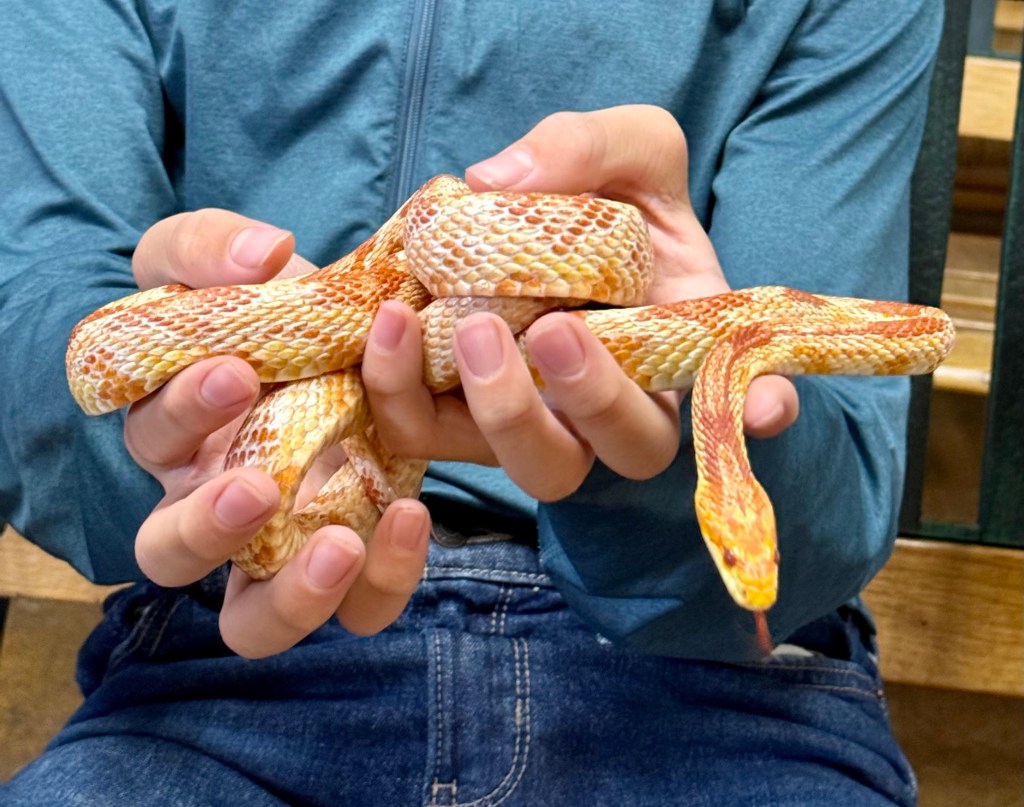
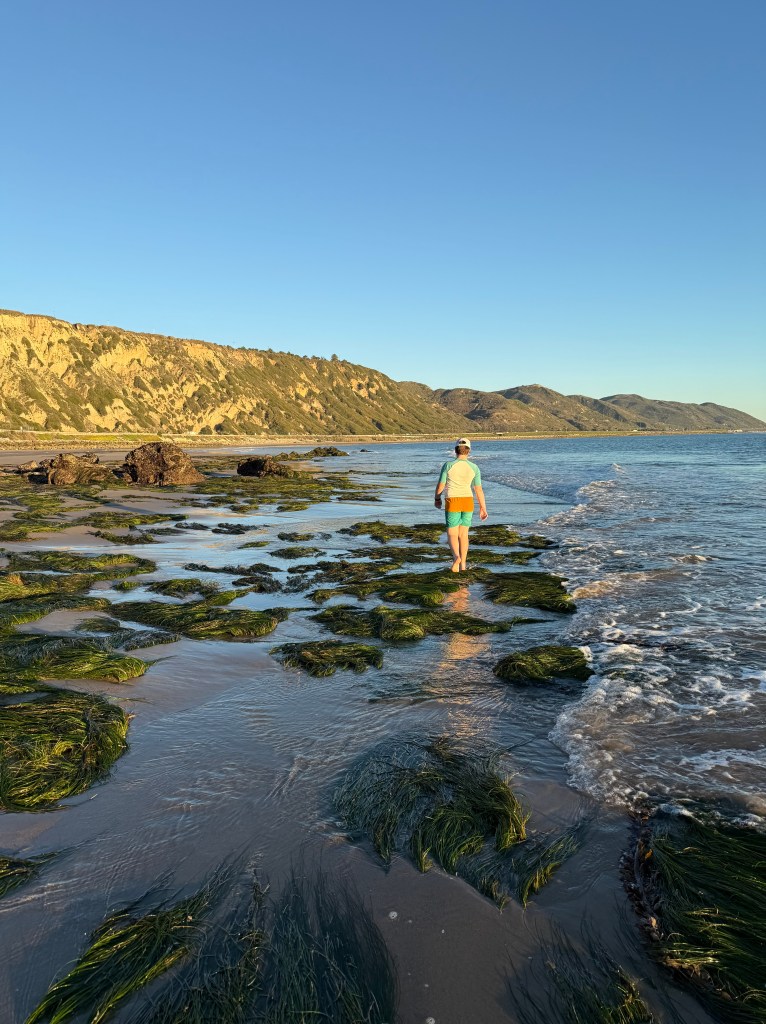
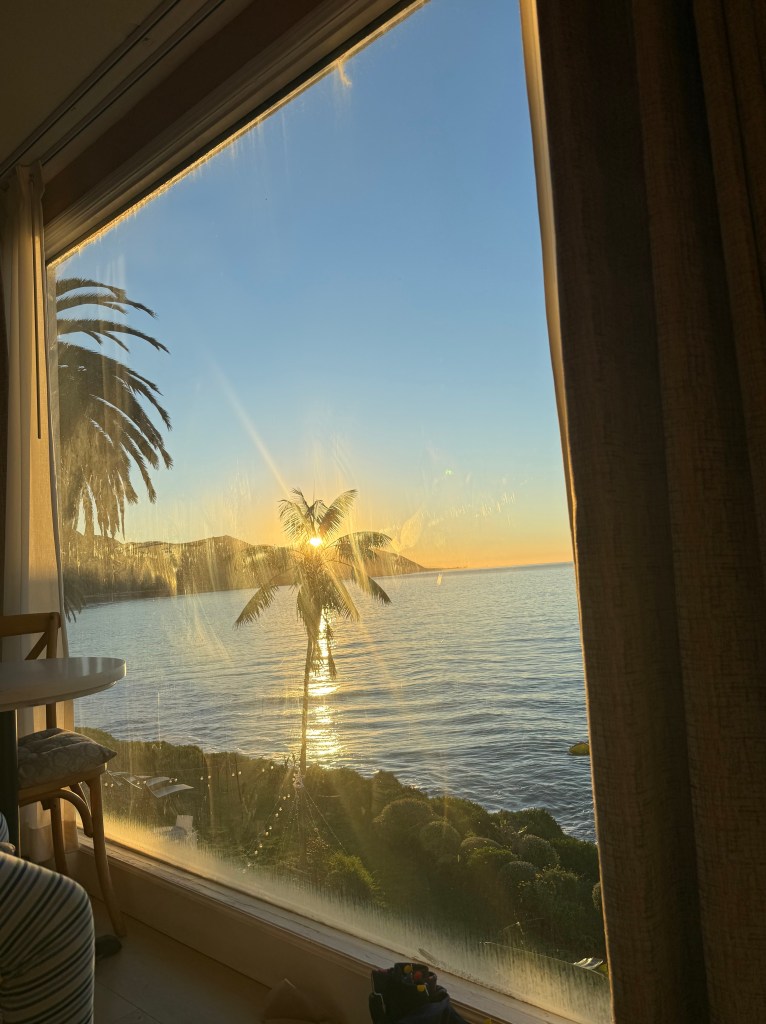
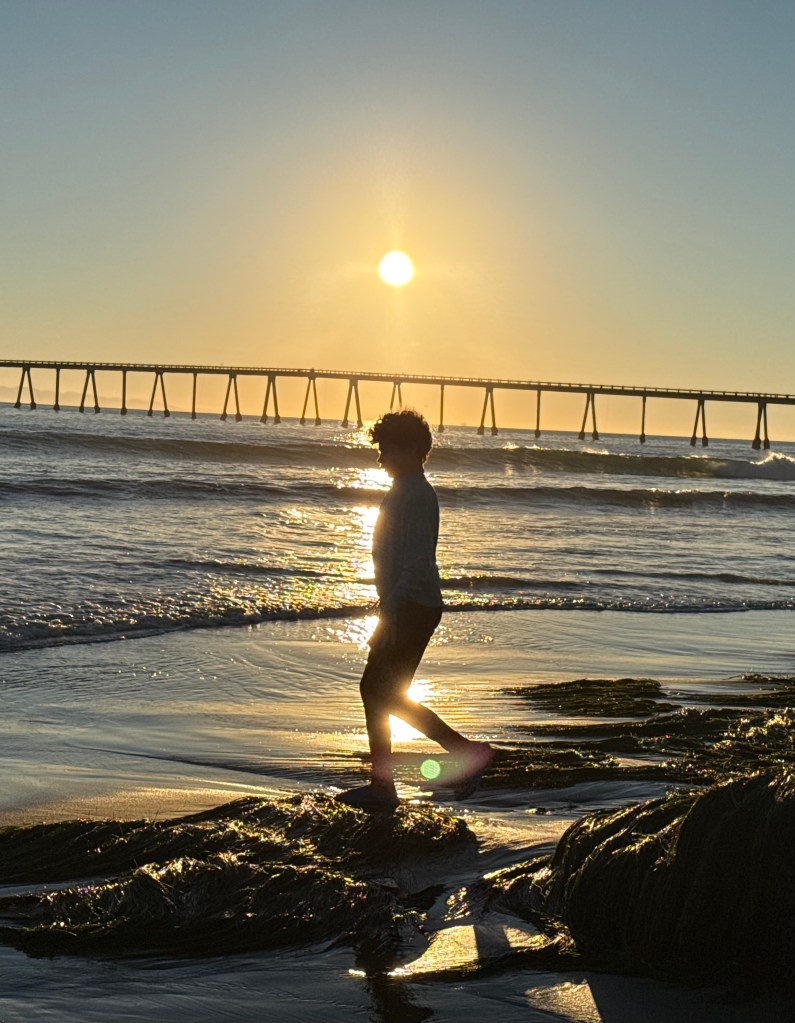
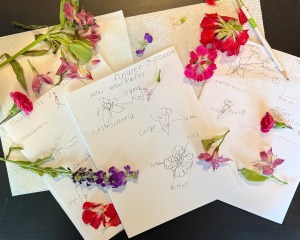
Our term three nature study was not as intense as I usually do, but we did go to a garden, dissect a cut flower, and purchased several garden flower baskets for the new house to observe.
Mathematics
M will continue with Math U See. He did not finish the book he was on in AO6, Epsilon, which deals with fractions. So we will finish that book and move on to Zeta.
Math in Review
Wow. Looking back on this, I have to laugh at my optimism when I wrote it last spring before we even finished out Year 6. As you can read in the Year 6 recap, by the end of the year I had given up on Math U See for M and figured out that we needed to take a different approach to math. I did some research on special ed math, talked to a friend who is a special ed high school teacher, and searched the internet for resources. What I decided needed to be done was focus on what is called “Funtional Math.” Things M will need to know to function every day in society. We spent a lot of time with Real Life Math Series, learning to solve money problems. Every week we also did lessons on telling time and time related word problems. The other days I added in simple graph reading exercises, simple math facts sheets (calculator prohibitied), and some basic fraction math. By the end of the year I could see progress. At the beginning, M would have difficulty determining whether he needed to add or subtract to solve a problem but by the end he could do it.
Art
AO Art and Artist Info Here and Music Info Here
In morning school there is an art/music slot in the schedule, so each day of the week we do either artist study, Lumen, Architecture, Composer, or Sound to Song.
Artist, Architecture, and Art History

This year we will study Pissaro and Jean Honorē Fragonard from the AO schedule and the studies from A Humble Place. The third option, Albert Bierstadt, is not one that we can view their works locally, so I will do more research to determine which artist we’ll study in term 3. I hope to find a non-European artist to substitue in. Since are not twelve paintings in a term, we also will also take a look at the ones that are available for us to view in local museums (LACMA, The Getty, The Huntington, Norton-Simon). And we’ll have some flexibility in the schedule for weeks we take a day to go to a museum.
We will also work through the next Lumen volume from Goldberry Press. We add this in once per week. There are not 36 lessons in the book, but again, we’ll have flexibility in the schedule.
For Architecture this year we will read through Mosque by David Macaulay. As we did with Cathedral last year, we’ll read a small section every week-ish. See Architecture page for a study guide on both books.
AO assigns The Story of Painting by H.W. Janson for Year 7. We have a copy of Janson’s History of Art for Young People, and since it is suggested as an alternative, that’s what we’ll use. I will be reading this to him one time per week.
Art in Review
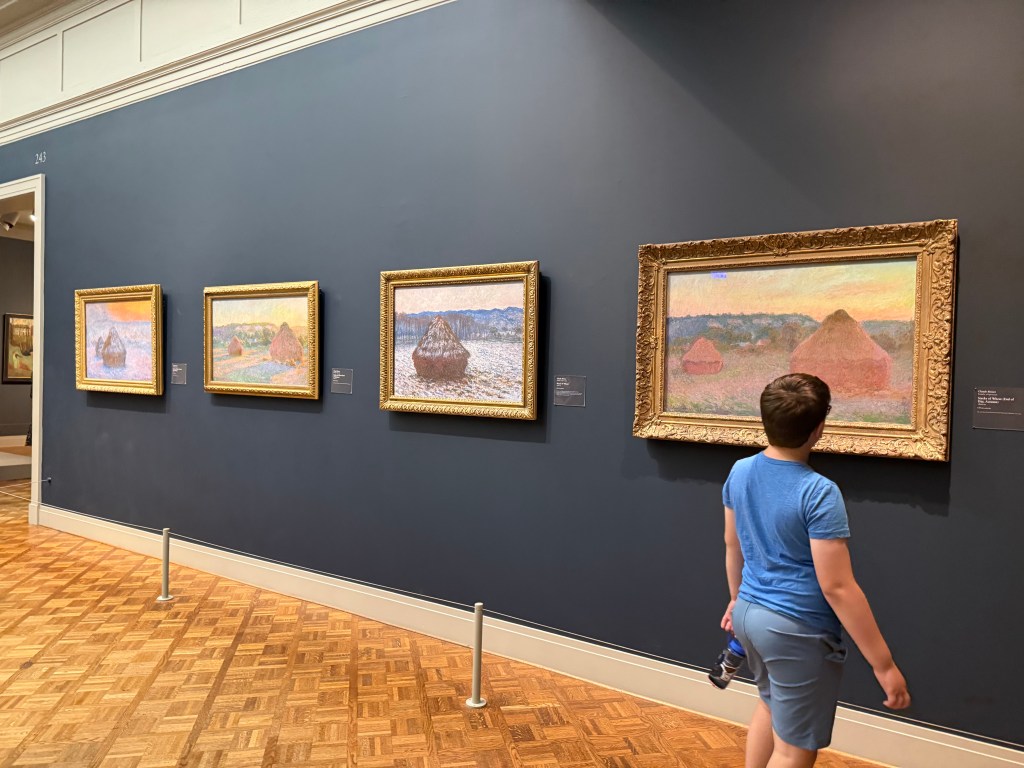
We did artist study pretty much as planned. Our trip to the Art Institute of Chicago was amazing for all of us. There was an entire room of Georgia O’Keeffe’s work as well as my favorite to see in person – Sky Above Clouds IV. Another casualty of The Move was finding museums in which to see Pissarro and Fragonard – I just didn’t have time to find. Lumen was also one of the things that would get left off out morning school during the craziness. We are enjoying Vol 2 and will continue working through it next year.
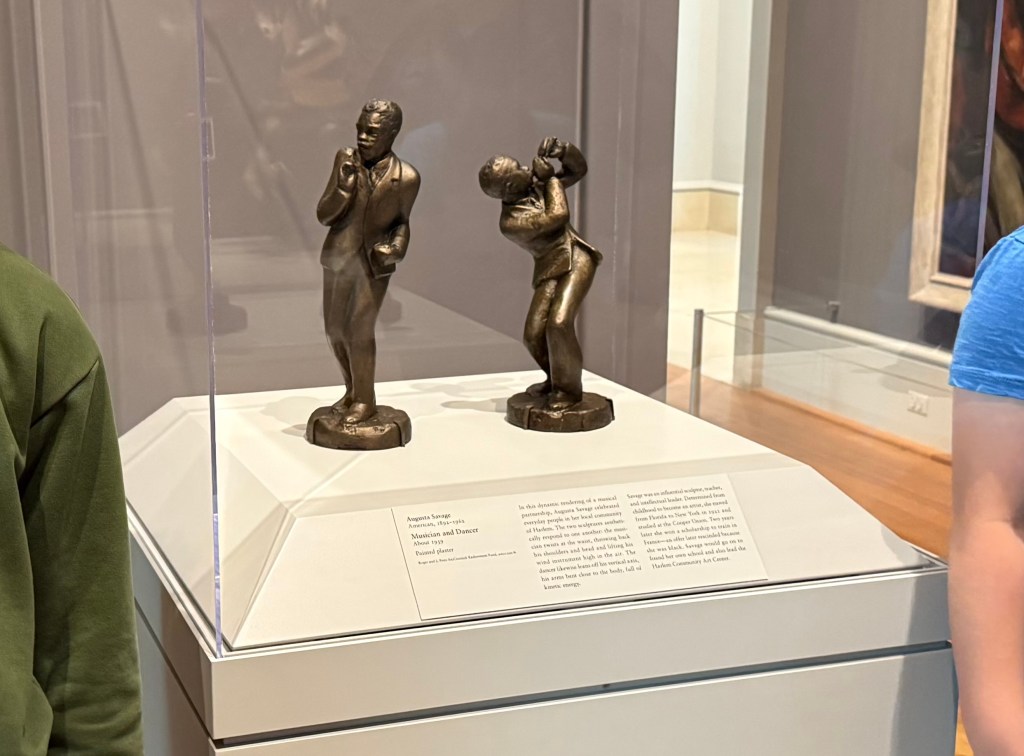
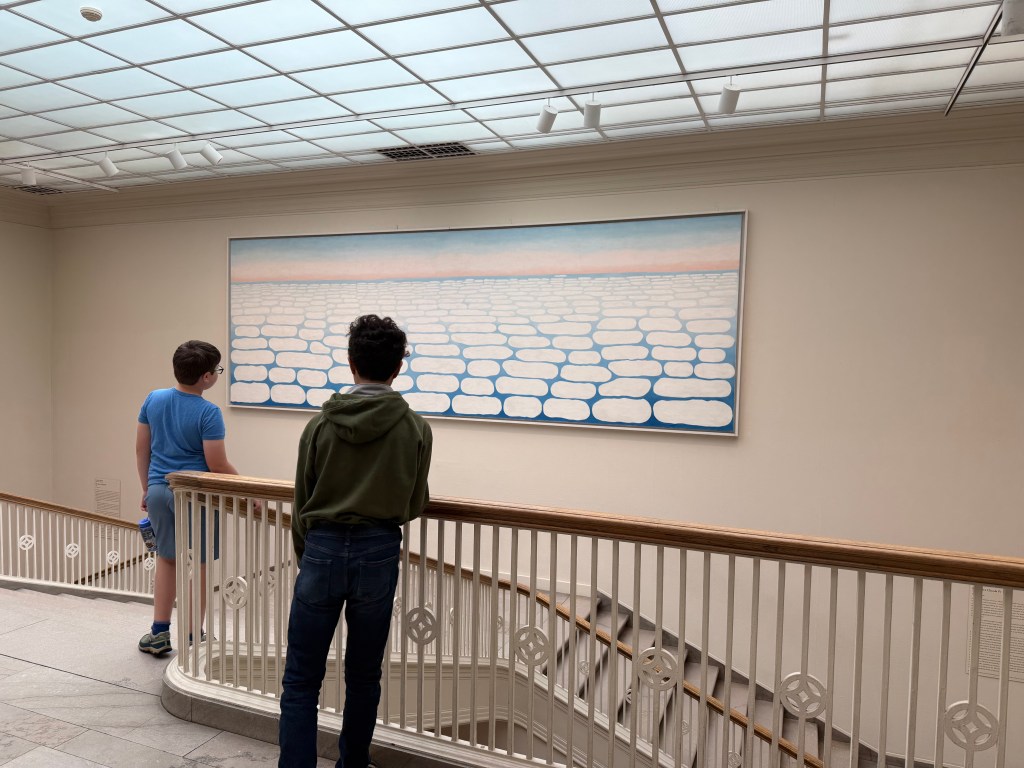
I started out reading History of Art for Young People but it was too advanced for M to follow most of it. Thankfully, I found an inexpensive copy of The Story of Painting. It is much more on M’s level. We made our way very slowly through the book. Many weeks during The Move we did not read it at all. Since this book spans multiple years, we’ll just keep moving slowly through it.
Composer
This year we’ll study Joplin for Term 1 (using the resources from Heritage Mom), Mozart for Term 2 (using either this short book or the Tillberry Table study) and Term 3 we’ll do Mendelssohn (using the Simply Charlotte Mason study).
Composer is on the schedule for once per week. During that time we either read from the book/study guide about the composer or we listen to a peice. I also put the peices in our “composer study” playlist that we sometimes have playing in the background.
This year I decided to add in the “From Sound to Song” study from ThistleandBiscuit.com to help us understand the elements of music better. We’ll be working through this study one time per week.
Composer in Review
I ended up using the Simply Charlotte Mason studies for all three artists this year and enjoyed them. The only difference was that we also read the biography recommended for Joplin by Heritage Mom. I plan on using these guides in the future when possible.
Hymns and Folksongs
We will continue to work learn new hymns and folksongs along with the AO rotation and use Hannah’s lovely YouTube postings at folksandhymns. I support her on Patreon and receive a monthly email with an mp3 of the music and a pdf of the lyrics. It makes my life so much easier! And with the mp3 I can create a playlist of hymns on my phone so we can listen to all our AO songs.
The monthly hymn is added to our family hymnal that is used during our Vespers time in the evenings (See Liturgical Year for how we have family readings and singing each evening). The folk song is learned during Together Time in the morning. We usually sing the current folk song twice a week and pick an old one to sing on Fridays.
Hymns and Folksongs in Review
We mostly kept up with the folk songs this year, but got a little behind on our hymns since we were not doing full Vespers in the evenings (see HERE for how we do Vespers). I keep wondering if or when they’ll get “too old” for folk songs, but it is still a favorite part of morning school. I have started to do the monthly folk song every day and then on Friday let them pick a “review folk song” for us to sing. Singing together in the morning is such a good way to start off our day.
Physical Education
M continues to participate in a swim club at the YMCA that meets twice a week for an hour. On the other days of the week, he actually enjoys learning about exercises that will “make his muscles big” and help with his swimming.
P.E. in Review
M swam twice a week for an hour until we left California at the end of January. I am proud of how well he was doing – the coaches were surprised to see his times at what they had to do for lifeguard training. Unfortunately, we haven’t found anything for him in Maryland yet. He has no interest in competing, so besides swim teams, I haven’t found anything for teens. I’ll keep looking. He has however kept up with his daily pushups and strength exercises so he keeps his muscles. I think next year I will formalize this for him.

