
PAGE IN PROGRESS
On this page I will write about how we incorporate the Church’s liturgical year into our daily routine. This includes Vespers in the evening, occasional readings and candles at dinner, and special celebrations like King Cake on Epiphany. I will be updating it through-out this upcoming year to include specific annual traditions.
On this Page:
- Overview of our Family Liturgy
- Advent
- The 12 Days of Christmas
- Epiphany
- Ordinary Time (between Epiphany and Lent)
- Lent
- Holy Week
- Easter
- Pentacost
- Ordinary Time
- Thanksgiving
Overview of our Family Liturgy
Why we do what we do
Both my husband and I grew up in “low” churches. The only part of the Church calendar that we were aware of was Christmas and Easter. Just the days – not the seasons. And not really even Advent until we were adults. I attended a Christian liberal arts college and was exposed to many new (to me) ways of worship and observing our faith. I was, and continue to be, attracted to the seasonal rhythms of the Church calendar. I even have a tiny bit of envy for the great old houses of Europe with chapels and mandatory family prayers every morning & evening. (Would it be crazy to build a chapel in the back yard? Can I just walk out the back door to pray in my personal chapel a la Gwyneth Paltrow’s Emma?)

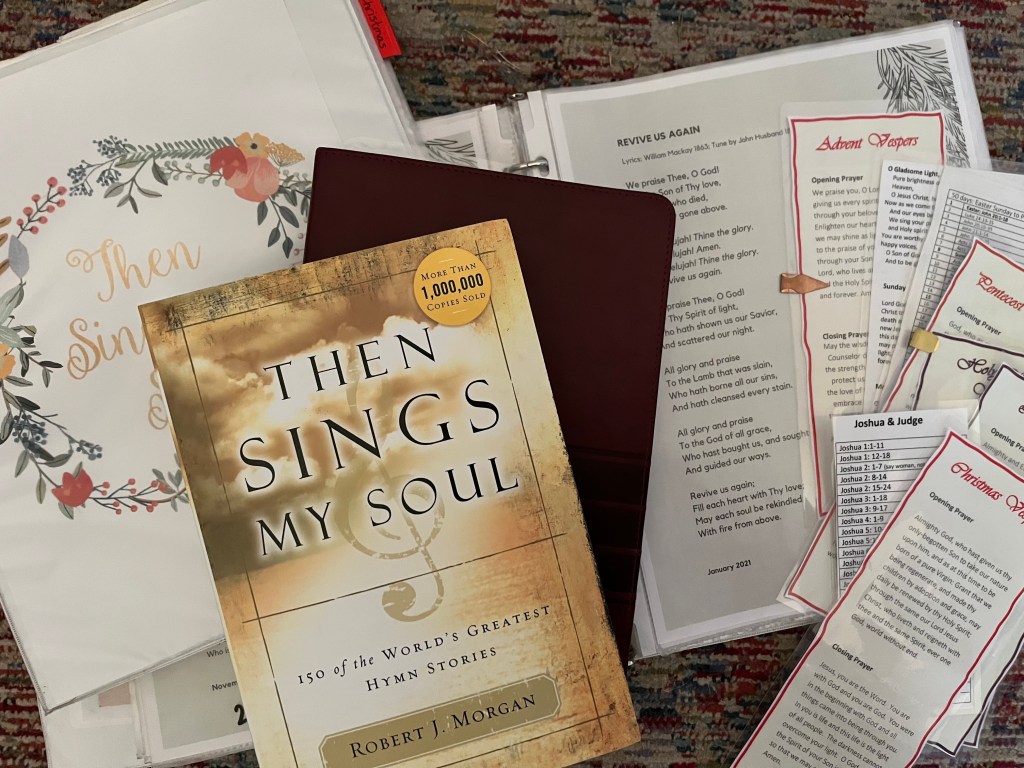
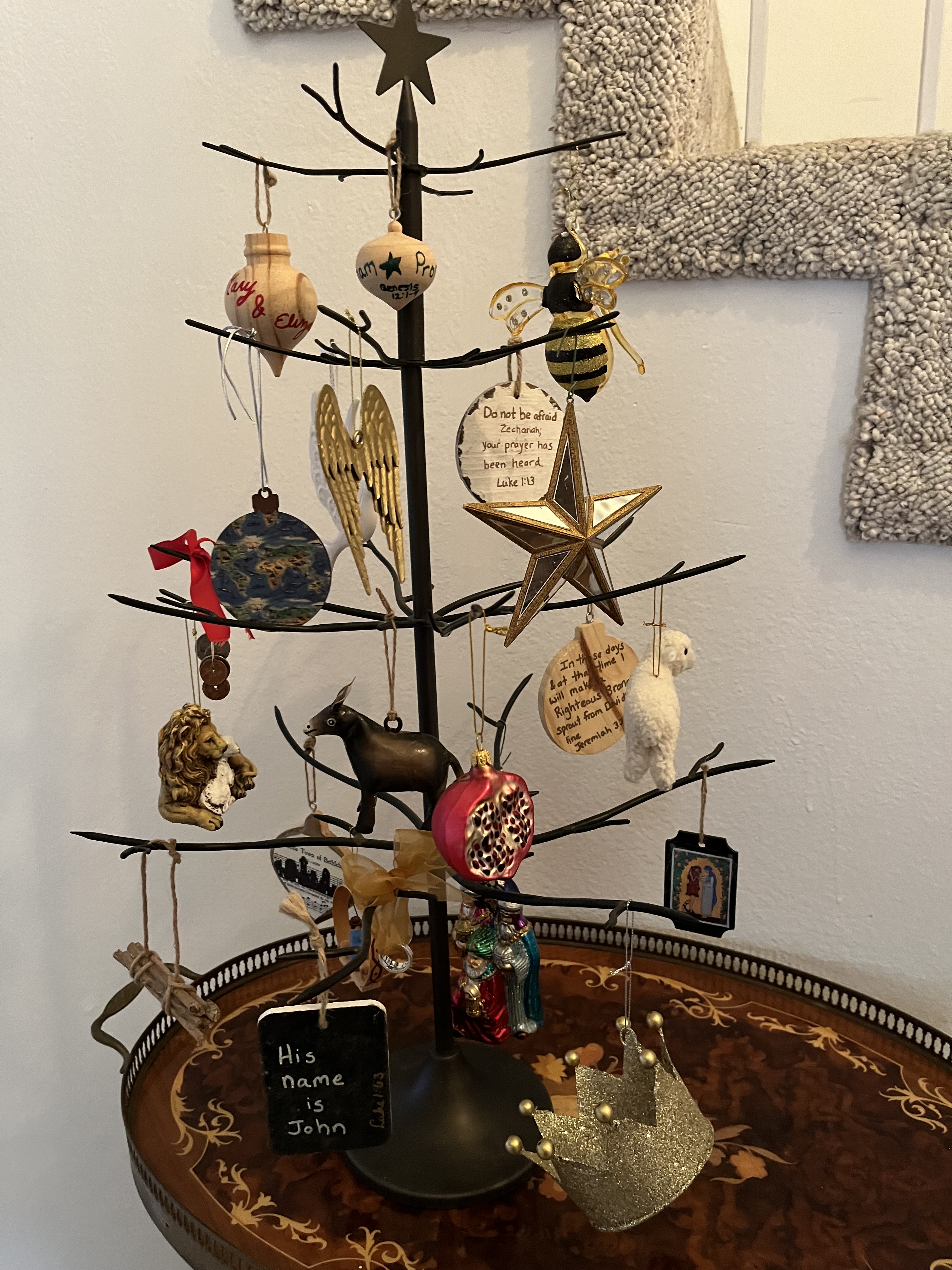
When kids came along, we decided to learn more about the Church calendar and incorporate it into our family life. The first, and easiest, was to start observing Advent. Every evening during Advent we read a verse and added a corresponding ornament to our “Advent Tree.” We started this with a 1 year old and 4 year old. By the time they were 3 and 6 we had added in singing a Christmas Carol after the readings and lighting an advent wreath at dinner. After Christmas that year we missed the evening routine we had been used to for a month. I realized that we had been learning hymns in our morning time, so why not keep the bedtime routine with our AO hymns? So we did. I made two binders with all the hymns printed out and at first we just read The Jesus Storybook Bible. We started calling this time together Vespers. Over the years we have added in special Sunday readings and seasonal prayers and readings. We’ve expanded our Family Liturgy to other times of the day and sometimes have special dinner candles and/or reading and occasional celebration meals.
The goal of our Family Liturgy was not merely to recreate a church service at home or make up new traditions. It was to create an atmosphere of faith in the home. We read in the Bible the following:
“Hear, O Israel: The Lord our God, the Lord is one. Love the Lord your God with all your heart and with all your soul and with all your strength. These commandments that I give you today are to be on your hearts. Impress them on your children. Talk about them when you sit at home and when you walk along the road, when you lie down and when you get up. Tie them as symbols on your hands and bind them on your foreheads. Write them on the doorframes of your houses and on your gates.”
Deuteronomy 6:4-9 (NIV)
Charlotte Mason’s oft quoted motto “Education is an atmosphere, a discipline, and a life” has influenced the development of our Family Liturgy. The atmosphere of our home is more likely to be one filled with worship if we have the discipline or habit of regularly making time to worship. And it is our life as the ideas we feed upon during our worship are the ultimate Living Ideas. It is our way of tying symbols on our hands, binding them to our foreheads, and writing them on our doorframes.
We did not want to be Jesus-followers on Sunday mornings only. We wanted to make time with God an intentional and normal part of our family routine. We wanted to find a way to remember that we are living in God’s story. As Tish Harrison Warren says in The Liturgy of the Ordinary: Sacred Practices for Everyday Life, “The liturgical calendar reminds us that we are people who live by a different story. And not just by a story, but in a story. God is redeeming all things, and our lives – even our days – are part of that redemption” (pg 113). We like the idea of participating in worship that our Church Family all over the globe and down through the centuries has practiced. We wanted to be an active part of the Communion of Saints.
Our goals for family worship are not to make sure our children know the right answers to Biblical questions or to make sure they can recite the important verses or believe the correct doctrine or understand the acceptable theology. We want not only our children, but ourselves to know and experience that God’s lovingkindness is better than life and that our souls are satisfied in God (Psalm 63). In her book The Lifegiving Table: Nurturing Faith through Feasting, One Meal at a Time, Sally Clarkson cautions us that “Mentoring and passing on faith is not about curriculum, church attendance, rules, or indoctrinations, but always about reaching the heart.” Our times of worship are not rigid, but leave room for questions, discussions, tantrums, and giggles. We hope to create a safe place to question and doubt, hope and love.
It took several months of “why are we doing this” questions, but after more than 3 years there is no more questioning why. There is always disruption and wiggles and day dreaming. Sometimes it seems useless or a waste of time or just one more thing to fit into an already busy day. But I am reassured by Henri Nouwen’s description of his daily time with God in the following passage from Gracias!:
“It is not an hour of deep prayer, nor a time in which I experience a special closeness to God; it is not a period of serious attentiveness to the divine mysteries. I wish it were! On the contrary, it is full of distractions, inner restlessness, sleepiness, confusion, and boredom. It seldom, if ever, pleases my senses… Still the Lord speaks to me, looks at me, and embraces me there, where I am still unable to notice it…God is greater than my senses, greater than my thoughts, greater than my heart. I do believe that he touches me in places that are unknown even to myself. I seldom can point directly to these places; but when I feel this inner pull to return again to that hidden hour of prayer, I realize that something is happening that is so deep that it becomes like the riverbed through which the waters can safely flow and find their way to the open sea.”
I believe what we are doing will not always make visible or dramatic changes in our lives. But I do believe God will honor our faithfulness. We are hopefully creating the habit of worship that will follow them through life. As Charlotte Mason says in volume 1, “The habits of the child produce the character of the [adult].”
How we do what we do
Since neither of us had experienced a liturgical year, the rhythms of the Church, or even knew what was on the Church calendar, my husband and I did some research and have experimented with different things over the years. We’ve only been doing this for several years, so I’m sure our family worship will continue to evolve. We have read multiple books and blogs and dived into the Book of Common Prayer. From this research we found prayers we find meaningful, readings we liked, Bible reading schedules that were helpful, and traditions we wanted to incorporate. The following have been influential to us:
- Many of our prayers come from the Book of Common Prayer.
- Some of our prayers and readings come from the book Living the Christian Year: Time to Inhabit the Story of God by Bobby Gross. This book helped us understand the rhythm and seasons of the year. It also gave us ideas on how to observe the seasons. We used the recommended readings for the first year, but have found other reading schedules more helpful lately.
- The Circle of Seasons: Meeting God in the Church Year by K.C. Ireton is a short book with many ideas on how to observe the seasons. Our candle lighting at dinner during several seasons follows the pattern described in this book.
- The Daily Office is an app from the Anglican Church of North America that follows the Book of Common Prayer. We used this for a while, but even though we don’t follow it exactly now, we have incorporated many of the prayers into our liturgy.
- We have just discovered the Fullness of Time series edited by Esau McCaulley and are in the process of reading through Lent: The Season of Repentance and Renewal in hopes of improving our family observations of Lent.
Though neither of us grew up using pre-written prayers in our churches or personal life, we have found them to be a useful tool for focusing our family worship times. C.S. Lewis talks about the usefulness of pre-written prayers in chapter 2 of his book Prayer: Letters to Malcolm. He acknowledges that “if they are our own words they will soon, by unavoidable repetition, harden into a formula. If they are someone else’s, we shall continually pour into them our own meaning.” He gives examples of advantages of using pre-written prayers (though he says he usually uses his own words): First “it keeps me in touch with ‘sound doctrine’…Secondly, it reminds me ‘what things I ought to ask.'” I find all of this true for myself- my own words tend to get repeated and almost become meaningless while pre-written words can become meaningful to me and help me focus on what I “ought” to be praying. We spent much time reading through the resources above to find prayers that are meaningful to us and help us to focus.
In the morning:
On school days we start our morning with a prayer and a Bible or church history reading (see the Planning pages for more details on what we’re reading now). We use St. Aquinas’ Prayer for Students to start our day. The boys come snuggle next to me as I pray that God, “the Origin of all Being,” will “give us a keen understanding, a retentive memory, and the ability to grasp things correctly and fundamentally.”
At dinner:
All year we have a candle in the middle of our little table to help designate dinner together as a special time. The power of a simple candle is emphasized over and over in Sally Clarkson’s The Lifegiving Table: Nurturing Faith through Feasting, One Meal at a Time. She says that when she “light[s] them at dinnertime, it calls all who sit at table to a sort of announcement that we are about to celebrate life together.” The boys love to take turns being the honored one to light (and then blow out) the candle. I change the candle depending upon the season. As I write this, it is in a pink votive holder for Valentine’s Day. Last month it was on a blue doily as we entered the winter Ordinary Time. During the summer we use a green candle as green is the Church color for Ordinary Time.

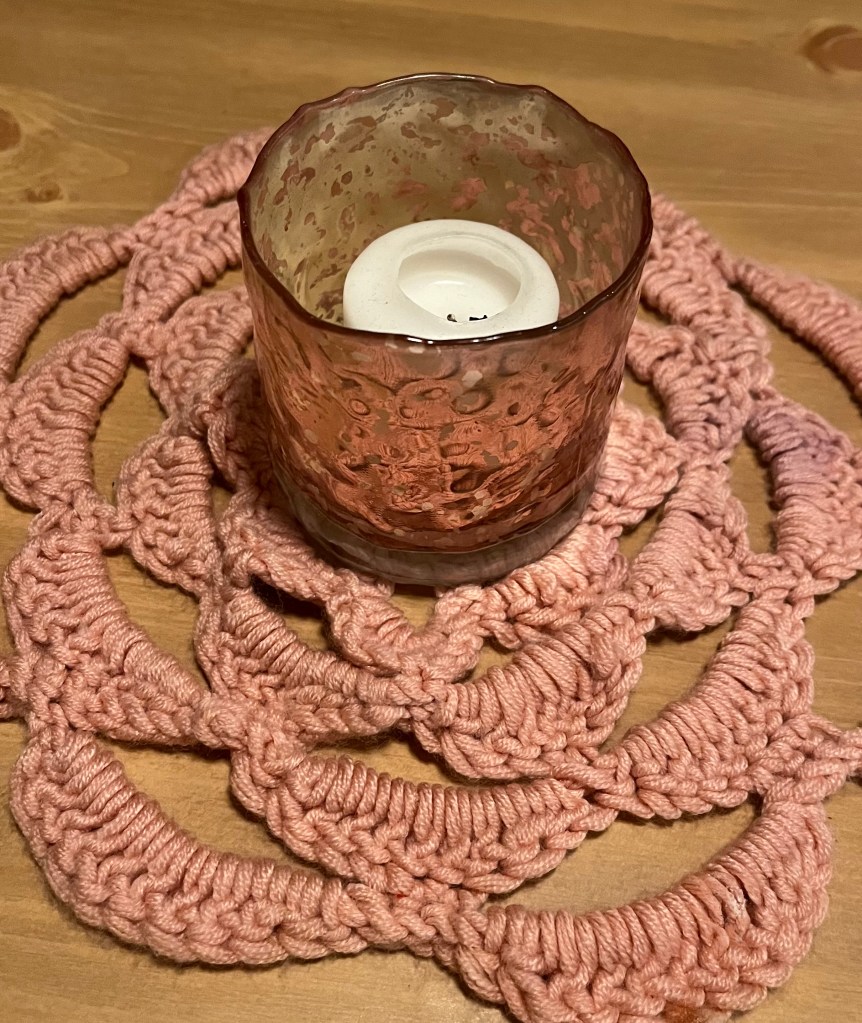
Some seasons we have a special Sunday readings at the table before eating (or every day during Holy Week leading up to Easter). These seasons usually also have a special candle or candles to be lit at the beginning of dinner. For Advent, we have the Advent wreath on the table, at Lent we have purple (and one pink) candles in the shape of a cross, and during Easter we have a single white candle representing Christ. I’ll write about each of these in more detail below.
Vespers:
As I described above, Vespers is our family worship time in the evening. After dinner and chores, the boys and Daddy get time to play (and Mama gets a break!). Before bedtime routine starts, we gather for Vespers. This is the usual “order of service” that usually takes about half an hour:
- Opening prayer read
- Bible Reading or special Sunday Reading
- Closing prayer read
- Hymn singing. M and Em each get to choose a hymn and then if time permits we may pick a third
- We each say what we are thankful for today and what, if anything, we want to ask God for
- Prayer time – whoever wants to pray may do so
The prayers and readings for each season of the year are on a laminated bookmark we use to keep our place in the Bible. As I described above, we have chosen prayers that are meaningful to us for each season and Bible readings that follow the season. I print the Opening and Closing prayers on one side and the readings for the season on the other side and laminate them into a bookmark.
The hymns are the ones we have learned from the AO hymn rotation. I have them all printed and put in page protectors in two “hymnal” binders with a Table of Contents at the front. There is a divider to keep the Christmas Hymns separate so we can sing them during Advent and the 12 Days of Christmas. Since neither my husband nor myself are musical, we sing along with a playlist I have made of the hymns. Most of them are from folksandhymns (she sends the MP3s of each recording to her Patreon supporters).
Sunday Readings vary. When M was in Year 2 we read through Little Pilgrim’s Progress on Sundays. Then we read through the Psalms (we didn’t finish that yet). Right now we are reading through Then Sings My Soul by Robert Morgan to learn about the hymns in our collection. Next year when Em is in Year 2 we will read through (or more probably, listen to an audiobook recording of) the original Pilgrim’s Progress. In the future I plan on including Parables of Nature in the schedule since we have not been reading it as assigned by AO.
Advent
We do not grasp the hope of Advent primarily through thinking about Advent but instead through immersion into the practices and prayers of Advent.
Tish Harrison Warren in Advent: The Season of Hope



Advent is a season for our imaginations to run wild as we contemplate a God who becomes human. We are given a wider glimpse of God when we allow Advent to be an invitation to dream beyond our comfort zones of what we think can happen in our lives or what God can do.
Enuma Okoro in Silence and Other Surprising Invitations of Advent
Growing up, I’m not sure either of us ever really heard the term “advent” associated with the time before Christmas. A week or two before Christmas our families set up a Christmas tree and sometimes we had a countdown calendar – 25 construction paper rings made in Sunday School or a 25-day paper calendar with little doors to open each day and reveal a Christmas themed picture. Advent was the first of the Church calendar we incorporated into our lives as adults and we have experimented with different readings and traditions over the years. We started with an Advent wreath when it was just the two of us and have expanded over the years as our family as grown.
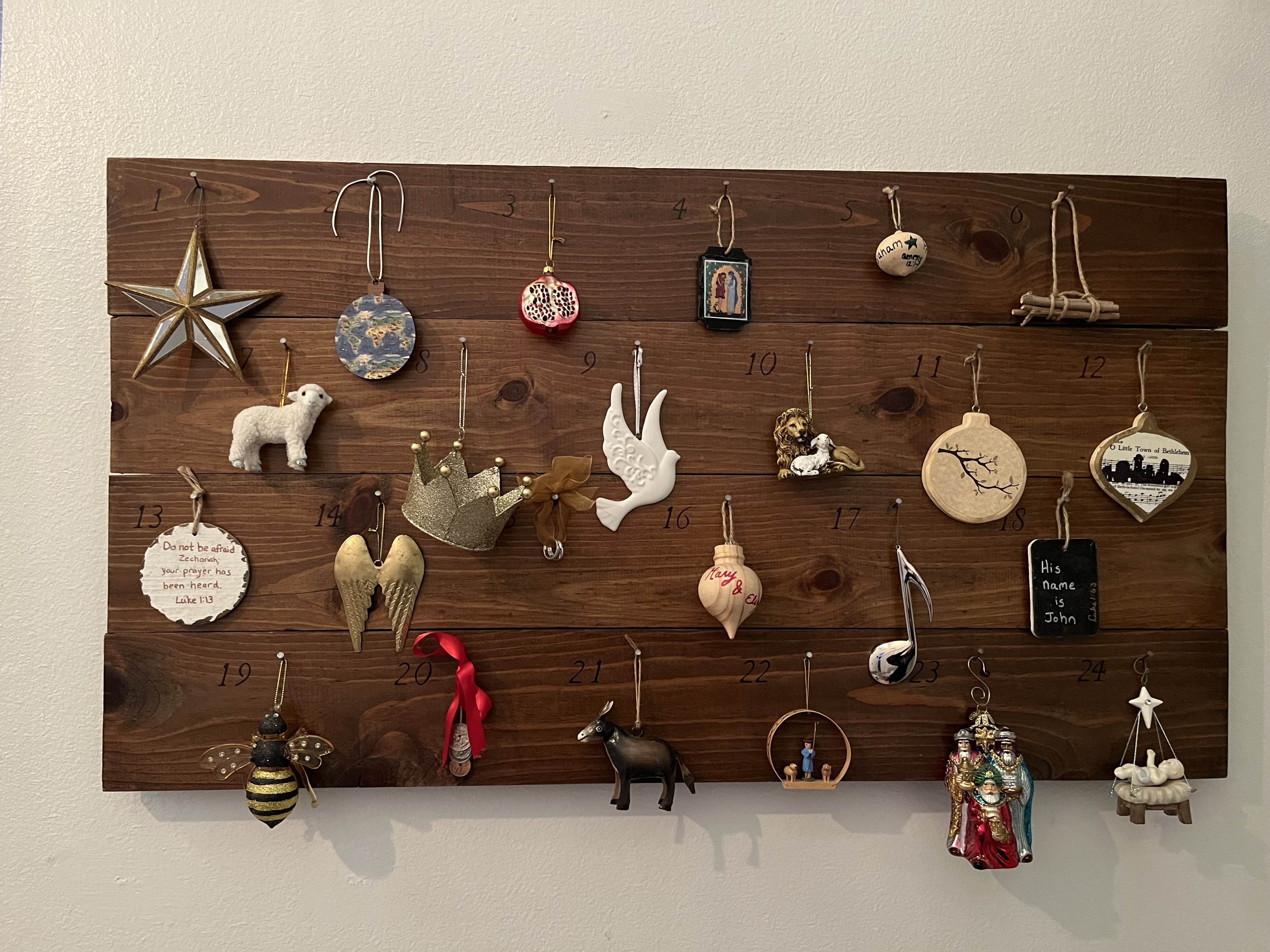
When kids came along, we decided we wanted a formal Advent observance we could do every year that would become a family tradition. We searched through the options available to buy or use online, but decided to create our own. We liked the ideas from the Jesse Tree and Unwrapping the Greatest Gift that follow along the story of the Gospel from the Old Testament culminating in the birth of Jesus. However, we prefered something a little more simple. So we came up with a list of stories and readings from the Old Testament and the Christmas story that we wanted to incorporate. We decided to just use 24 readings starting on Dec 1 to keep the number of days consistent each year. Then we found or made ornaments that symbolized the reading. Each night after the reading, we sing Christmas Carols and then hang the day’s ornament on the ornament tree. As we get closer to Christmas, the tree fills up and the ornament board counts down the remaining days.
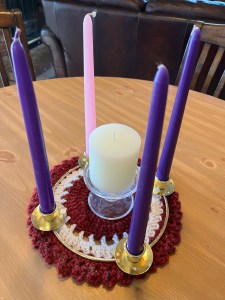
We wanted to still keep our Advent Wreath, so we decided to use that during dinner. So each of the four Sunday’s of Advent we have a short reading before dinner and light a new candle. There are many different ways to observe the four weeks of Advent, but we have settled on the following:
- Week One: Hope. We read about how Isaiah prophecied about the Messiah and how we have hope that Christ will be with us now and in the future. The youngest child lights the first purple candle each night.
- Week Two: Prepare. We read about John the Baptist and how we can prepare our hearts for celebrating Christmas and discuss what it means to be prepared for being with Christ in the New Creation. The oldest child lights the first and second purple candles each night.
- Week Three: Rejoice. We rejoice with Mary and Elizabeth that God “has done mighty deeds.” Mama lights the first two purple candles and the pink candle each night.
- Week Four: Love. We read John 3:16-17 to remind ourselves how much God loves us. Daddy lights all four candles every night.
- Christmas Eve we read John 8:12 remembering that Jesus is the Light of the World and light the white Christ Candle in the middle of the Advent Wreath.
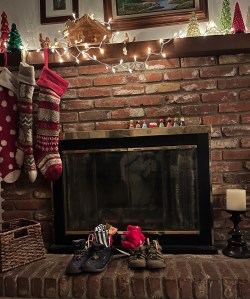
Recently we have added into our Advent celebrations a simple observance of St. Nicholas Day (Dec 6th). On the evening of December 5th we read the story of St. Nicholas during Vespers. We read the version from our book Stories of the Saints by Carey Wallace. Then the boys leave a pair of shoes on the hearth. In the morning they find their new Christmas Pajamas for the year and some candy coins. I have hopes of incorporating making traditional molded cookies on St. Nicholas Day, but I have yet to successfully bake them ;).
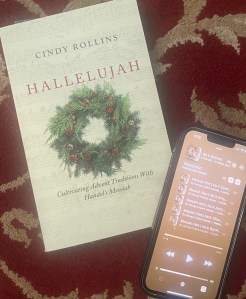
During Morning Time we work our way through Hallelujah: Cultivating Advent Traditions with Handel’s Messiahby Cindy Rollins. She includes many ideas for observing Advent, but the part of the book we use is her listening schedule for Handel’s Messiah. She has it broken into 4 weeks, with 6 days each week. Since we do not ususally do school that many days in December before Christmas break, we listen to two or more of the selections each morning. I read the Scripture passage and the lyrics before listening to the music. Since we are doing this, we do not do a hymn or folksong for the month.
Advent is definitly the season with the most traditions, but even with all I described above and adding in other things such baking, decortating the tree, gift exchanges, or looking at Christmas lights, our season is not overly busy. We keep things flexibe so that if we miss a reading in Morning Time or Vespers, we just make it up the next day. I have all the hard work of planning already done, so the actual celebrations get to be relaxed.
Below are the readings we use for Vespers and Sunday dinner:
- Vespers reading bookmark (with ornaments listed)
- Sunday dinner readings for Advent Wreath
Books and Resources I have used to develop our liturgy (other than the ones listed above in the How we do what we do section):
- – Advent: The Season of Hope (Fullness of Time series) by Tish Harrison Warren
- – Seven Bells to Bethlehem: The O Antiphones by Oliver Treanor
- – Hallelujah: Cultivating Advent Traditions with Handel’s Messiah by Cindy Rollins
- – Silence and Other Surprising Invitations of Advent by Enuma Okora
- – Advent and Christmas: Wisdom from G.K. Chesterton
12 Days of Christmas
“If Advent is a season of waiting, Christmas is a season of wonder.”
Bobby Gross (Living the Christian Year)

“If we as the church have been actively waiting through the weeks of Advent fo the coming of Christmas, then, unlike our cultural counterparts, we will not be ready to simply toss aside the Christmas season along with the wrapping paper and ribbons on December 26 – and we will not need to. We will have eleven more days to celebrate with joy what my pastor calls ‘a long, slow Christmas.’” K.C. Ireton (The Circle of Seasons)
Since we’ve been learning about how to keep the Church Calendar in our family liturgy, we’ve tried to figure out the best way to incoprorate the celebratory 12 days of Christmas. Through-out the four weeks of Advent, we participate in our culture’s Christmas festive celebrations – light shows and Nutcracker Ballets and A Christmas Carole performances and parties and cookie baking and gift exchanges. Even though the Church’s Advent is a more somber time focusing on our need of a saviour, we let the celebratory part of Christmas sneak over into our Advent.
But we’ve started to celebrate the 12 days of Christmas too so that we distinguish Advent from Christmas and spend time in awe of the incarnation. Some of the things we do to keep Christmas time separate from Advent are:
- Keep a Christmas tree up and some of the lights (because Christ is the light that has come into the dark world). We have a large tree in the picture window of the “library” of our home where we do school lessons and Vespers. But we also have a small tree in the “family room,” and it is this one that we keep up through the 12 days.
- Save some of the special occasions like light shows for these weeks.
- Continue singing Christmas Carols during Vespers.
- In place of the advent wreath at dinner, we light the white Christ Candle and recite the following:
Candlelighter: Jesus Christ is the Light of the World
Everyone Else: The Light no Darkness can Overcome
We focus our Vespers readings on the part of the Christmas story that comes after the birth for the first week, then in contemplating the miracle that is the Incarnation for the last days. This is the bookmark we use with our prayers and readings. This includes:
- The Magi visit
- The Escape to Israel
- The Commemoration of the Holy Innocents
- Prophecies of what the Messiah will do
- Reading about the Naming Day on Jan 1
We wait to read the story of Anna and Simeon until The Feast of the Presentation on Feb 2 when Mary takes Jesus to the temple with her for her own purification to happen 40 days after giving birth.
I have used ideas from Living the Christian Year by Bobby Gross and The Circle of Seasons by K.C. Ireton for our readings and traditions.
Epiphany

This was another new observation for us, so the research took a while and we are still experimenting with it. The Season of Ephiphany in the Church Calendar is from Jan 6 through to Ash Wednesday. But we have decided, for now, to observe the Day of Epiphany as a closing to the Christmas season as the day to observe the arrival of the Magi. The way we do this is by inviting friends over for a meal and to share a King Cake. This is the recipe I use (though after about 5 years of making it, I’m still in the practicing stage!). The first year I made the King Cake we were still “social distancing,” so I made multiple small cakes and delivered them to our group of friends with this document with suggested readings and an explanation of the King Cake. Since then we have continued to read it before our shared meal.
Since my reading about the Season of Epiphany showed that it focuses on the life of Christ, we spend the “Ordinary Time” before Lent reading through on of the Gospels.
Ordinary Time (between Epiphany and Lent)

January 7th through Fat Tuesday (the Tuesday before Lent starts) we read through the Gospel of Luke. We don’t have a set schedule of reading, but just read a passage each day. If we don’t make it through, we don’t. All Christmas decorations are put away and replaced with simple (usually blue) decor. There are four “special” days we observe:
- The Sunday after January 6th is a day to read about Jesus’ Baptism. We interrupt Luke to read one of the baptismal accounts, either Mark 1:1-11 or Matthew 2:13-17.
- Candlemas or Presentation Day is February 2nd. 40 days after Christmas (giving birth) Mary goes to the temple for purification and Jesus is presented. We read the story of Simeon and Anna in Luke 2:22-40.
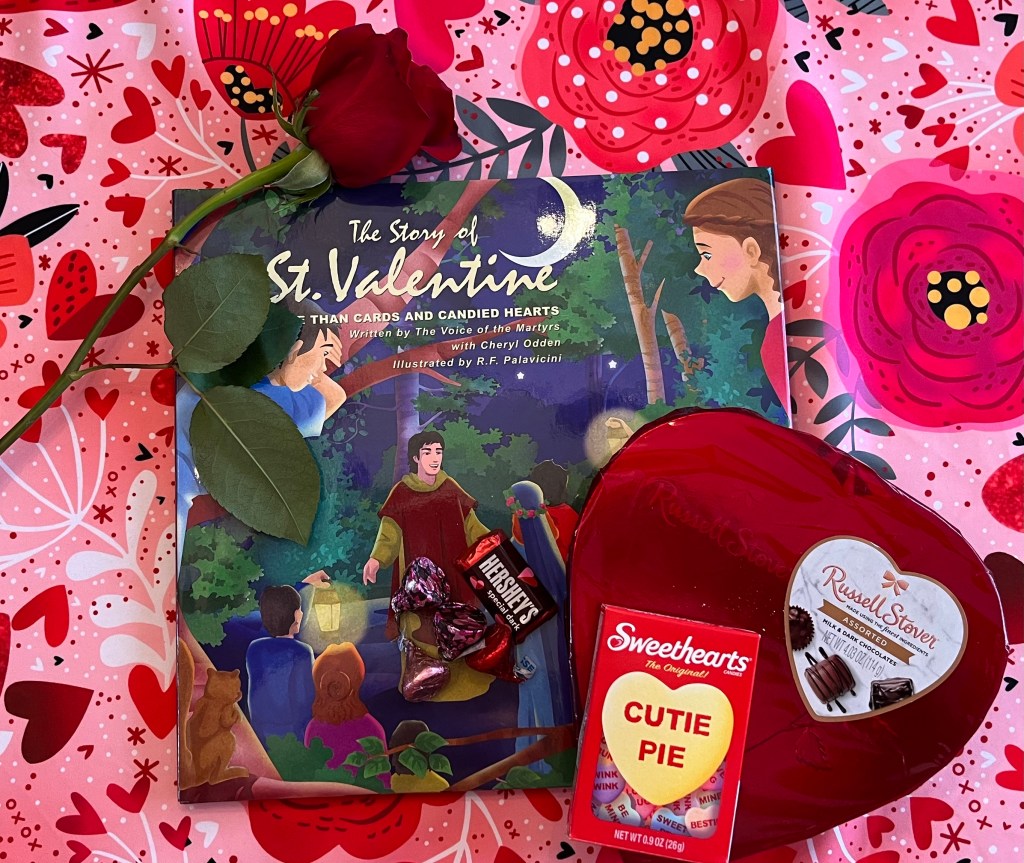
- Valentine’s Day usually falls within this time so we read a story book telling (one account) of the life of Saint Valentine. And of course, we make the day special by decorating a little, exchanging cards, and having a favorite meal together. (Date night is done a different day since we’ve always been disappointed when trying to go out on Valentine’s Day itself.)
- Fat Tuesday or Shrove Tuesday is the day before Lent starts and traditionally the day to use up all the butter and good stuff in the house in preparation for the fasting of the Lenten season. One way to do this is to make pancakes. We have tried several traditional Shrove Tuesday recipes, but have fallen back on our family’s favorite recipe. Eating pancakes for dinner is a treat for most of us (and the
husbandunnamed one who dislikes Breakfast for Dinner submits in the spirit of the day.)
Lent
In the liturgical year there is never celebration without preparation. First we wait, we mourn, we ache, we repent. We aren’t ready to celebrate until we acknowledge, over time through ritual and worship, that we and this world are not yet right and whole. Before Easter, we have Lent. Before Christmas, we have Advent. We fast. Then we feast.
Tish Harrison Warren (Liturgy of the Ordinary)
Part of the rhythm of the Church calendar is the fasting and feasting, reminding us that Kingdom of God is Here and Not Yet. Finding a way to observe this cycle with young children was challenging. We wanted them to understand the reason for rejoincing on Easter, but to fully understand that, they would have to understand the reason for sadness during Lent. After much searching the interwebs for ideas on how to observe Lent with children, we came up with the following:
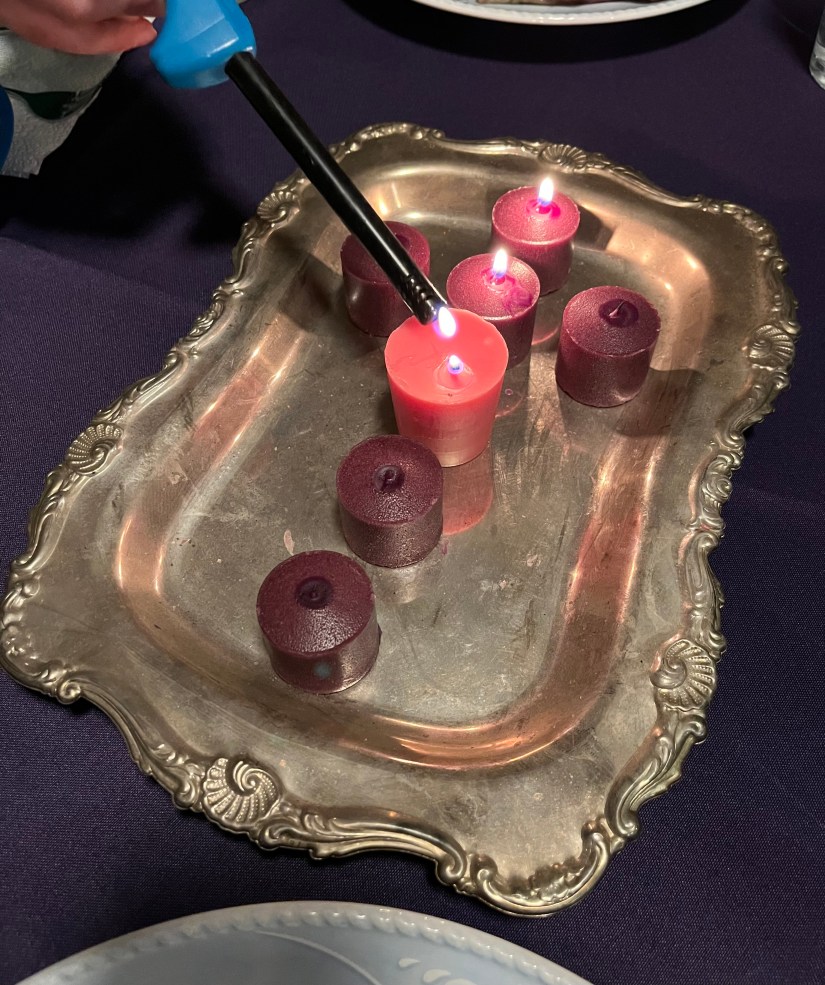
- On Ash Wednesday at dinner, we disuss what Lent is and how we are going to observe it. We light 7 votive candles – 6 purple and 1 pink – in the shape of a cross.
- Each of the following 5 Sundays we read a Scripture passage. We light the candles from the previous week and blow one out. So each week one less candle is lit. Blowing out the candles brings us closer to the darkness of Good Friday. Here is a word document of our Sunday Dinner Readings.
- In morning time, we read through The Sacred Sacrifice: Cultivating Lenten Traditions with Bach’s Great Passion by Hannah Paris. In the past we have followed along with the listening schedule using the recommended recording. This year I found this performance by the Netherlands Bach Society on You Tube. It has been pretty simple to follow along with the suggested listening. The boys are much more interested in the music when they can see the performance.
- During Vepers we read through the story of Joseph and the Exodus. Here is a word document of our Vespers Reading Bookmark. We learned that it is tradition not to sing any hymns that have the word “Hallelujah” in them during Lent, so we follow that when choosing hymns to sing during this time.
- We don’t decorate for Easter. During lent we are not celebrating the new life and resurrection; we are remembering our need for a Saviour. So in place of Easter decorations, I have a few purple decorations around the house to remind us of the Lenten season.
Holy Week

“Taken together, the death and resurrection of Jesus form the heart of the Christian Story, thus [this week] represents the center of the Christian year.”
Bobby Gross (Living the Christian Year: Time to Inhabit the Story of God )
Palm Sunday through Holy Saturday are still part of Lent, but I’m giving them their own section here because this week is special as it leads up to Jesus’ death and resurrection. During this week, starting on Palm Sunday, we have a reading every evening at dinner and during Vespers we read through the Gospel story of the week. This week at dinner we light a single candle during dinner and blow it out on Maundy Thursday as we begin reading the crucifixion story. The candles stay dark until we can celebrate the resurrection on Sunday. Here are the readings we use:
Easter
We need the season of Easter, the Great Fifty Days, to live with the mystery of resurrection for a while, to let the magnitude of it dawn on us, dawn in us.
K. C. Ireton (The Circle of Seasons: Meeting God in the Church Year )

Growing up we had two days on our “church calendar:” Christmas and Easter. Adding in Advent and Lent came as adults. But as we started settling in to a liturgical year with our children, we discovered that we had been missing out on the most important season of all: Easter. We had been spending a month preparing ourselves for the birth of Christ, a couple of months lamenting the need of a Saviour, but then one single day rejoicing that we have one. K.C. Ireton points out, we have “relegat[ed] the most important event in all history to a single day.”
In an attempt to celebrate the resurrection in a more meaningful way, we have embraced the fifty day seaon of Easter. During Lent we have had a few purple decorations around the house and no flowers. But on Easter morning, the boys wake up to not only token Easter gifts and an Easter Egg Hunt, but to the Easter decorations and flowers. I keep the decorations up for the full 50 days (into June some years!!) to remind ourselves that Easter is, indeed, the most important event in all of history.
During Easter we light a white candle at dinner and remind ourselves that Christ is Risen, He is Risen Indeed! Every Sunday during Easter Season we read a scripture at dinner reminding us of what Christ has done for us. During Vespers we read through the Book of Acts.
Pentacost
Candlelighter: Come Holy Spirit
Others: Holy Spirit Come

This is part of the Liturgical Year we haven’t figured out yet. We light a red candle at dinner on Pentecost Sunday and the following week, read Acts 2 at Vespers, and take down all the Easter decorations. This may evolve into more, but we’re keeping it simple for now.
Ordinary Time
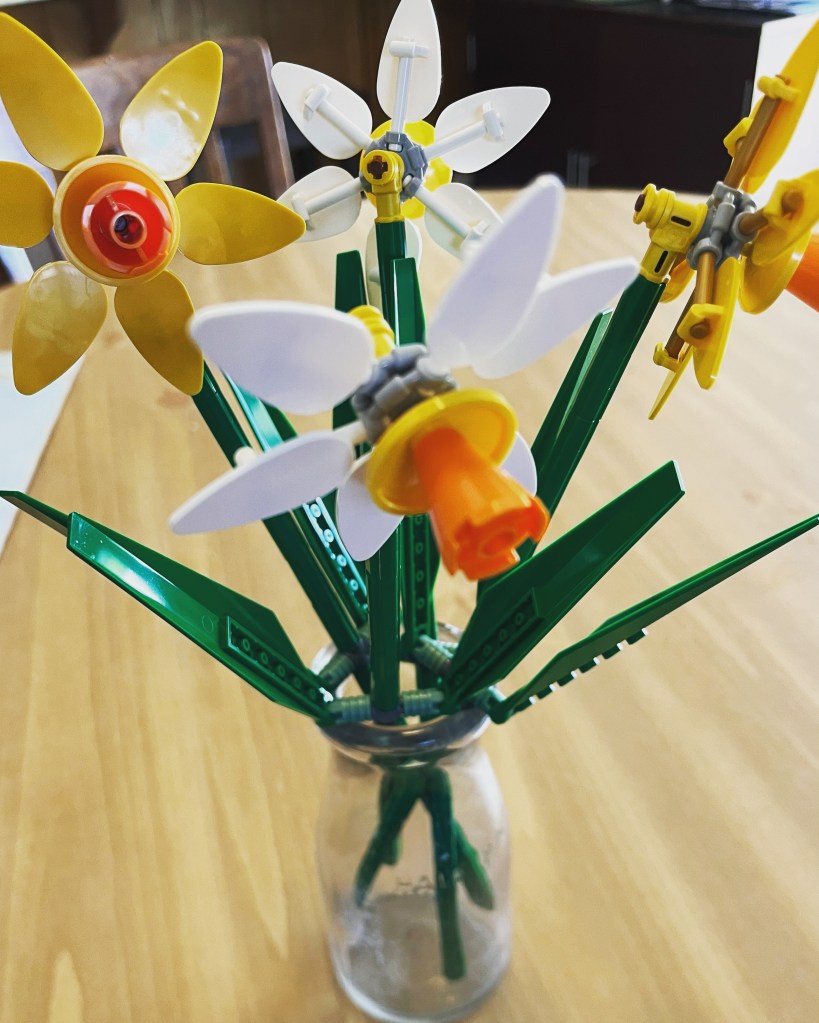
From Pentecost through Thanksgiving is Ordinary Time. I have no special decor or dinner table readings or candles. The color for Ordinary Time is green, so at the beginning I may have a green candle on the dinner table, though my new favorite are my LEGO flowers from my boys is my current decoration. But this time also includes the 4th of July and Fall and Halloween, so the house will get decorated for those occasions too.
During Vespers, we read through the Old Testament reading for M’s year in the Ambleside Online Schedule. On Sundays we have a special reading. This has included reading through Little Pilgrim’s Progress, listening to an audio recording of the original Pilgrim’s Progress, and reading the stories of the hymns in our collection in Then Sings My Soul. In the future I plan on reading through Parables of Nature and possibly Trial and Triumph.
Bookmarks for Old Testament Reading during Ordinary Time:
- AO2: Genesis
- AO3: Joshua, Judges and Ruth
- AO4: I and II Samuel
- AO5: 1 and II Kings (includes bookmarks with reading schedule, maps, and links to resources)
Thanksgiving (usually last week of Ordinary Time)
While not officially part of the Church calendar, and techinically still part of Ordinary Time, we take the week of Thanksgiving to remember and to be thankful. As we are ending our Church year and about to head into the start of a new Church year with Advent, that this last week of the Church year (usually) coincides with American Thanksgiving week seemed like a good opportunity to look back at the year and remember and be thankful for all God has done for us.
With this in mind, we decided for the week of Thanksgiving, to focus our week on the examples in the Bible of how God’s people remembered God’s goodness. There are several examples of people placing stones as a way to remind them of what God did for them. When Samuel erects a stone to remember God saving them from the Philistines, he calls it an “Ebenezer” or “Stone of Help.” When Joshua leads the people over the Jordan, he takes 12 stones from the Jordan to build a memorial as a sign to future generations to remember how God helped them cross. When God visits Jacob in a dream, he erects a stone to commemorate the location. And there are many Psalms in which praises to God are sung, remembering how God has been faithful to the people over the generations. The connection between remembering God’s faithfulness and having a grateful spirit is undeniable – we cannot be thankful to God uness we remember what God has done.
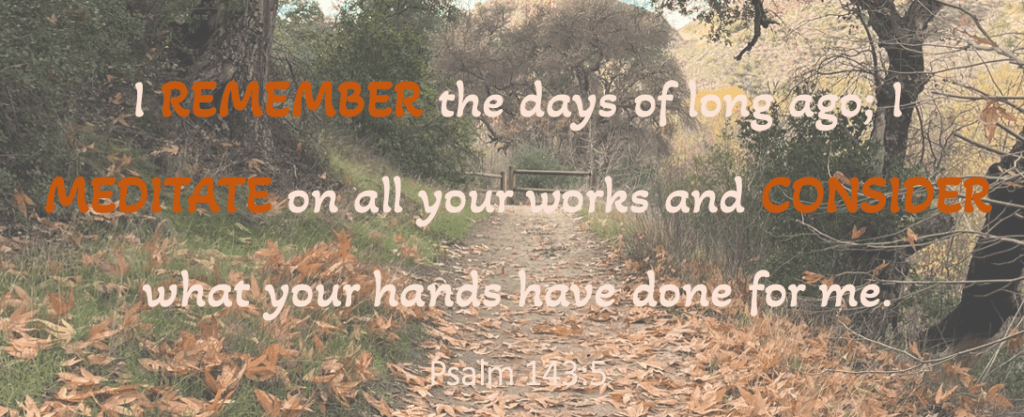
In Vespers this week we read about the examples of remembering and thankfulness in the Bible. Each evening we read Psalm 143:5 in hopes of memorizing (or rememorizing) it by the end of the week. We also choose to sing some of the hymns from our collection that focus on remembering God’s goodness and being thankful.
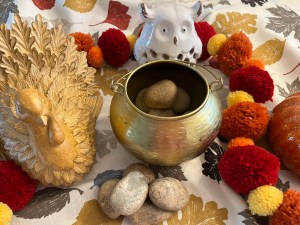
We are going to try something new this year. As an homage to the 12 stones Joshua placed as a memorial, on the last Sunday of each month starting in December we will write on a stone something our family is thankful for that happened in that month. Then, on the Sunday of Thanksgiving week next year we will write out 12th thankful stone and “raise our Ebenezer” to be our reminder of all that we have to be thankful for from the previous year. This year, since we’ve just decided to do this, we’ll start on the last of September and each of us will write on one rock. That way after October and the Sunday before Thanksgiving, we’ll have 12 things to be thankful for and remember. I’ll let you know how this goes!
This is a link to the bookmark I use for our Vespers prayers, hymns, memory verse, and readings.
 Ambling Together